Reducing Revision Rounds as a Creative Efficiency Metric
Fewer revision rounds reveal process breakdowns that extra talent never fixes.
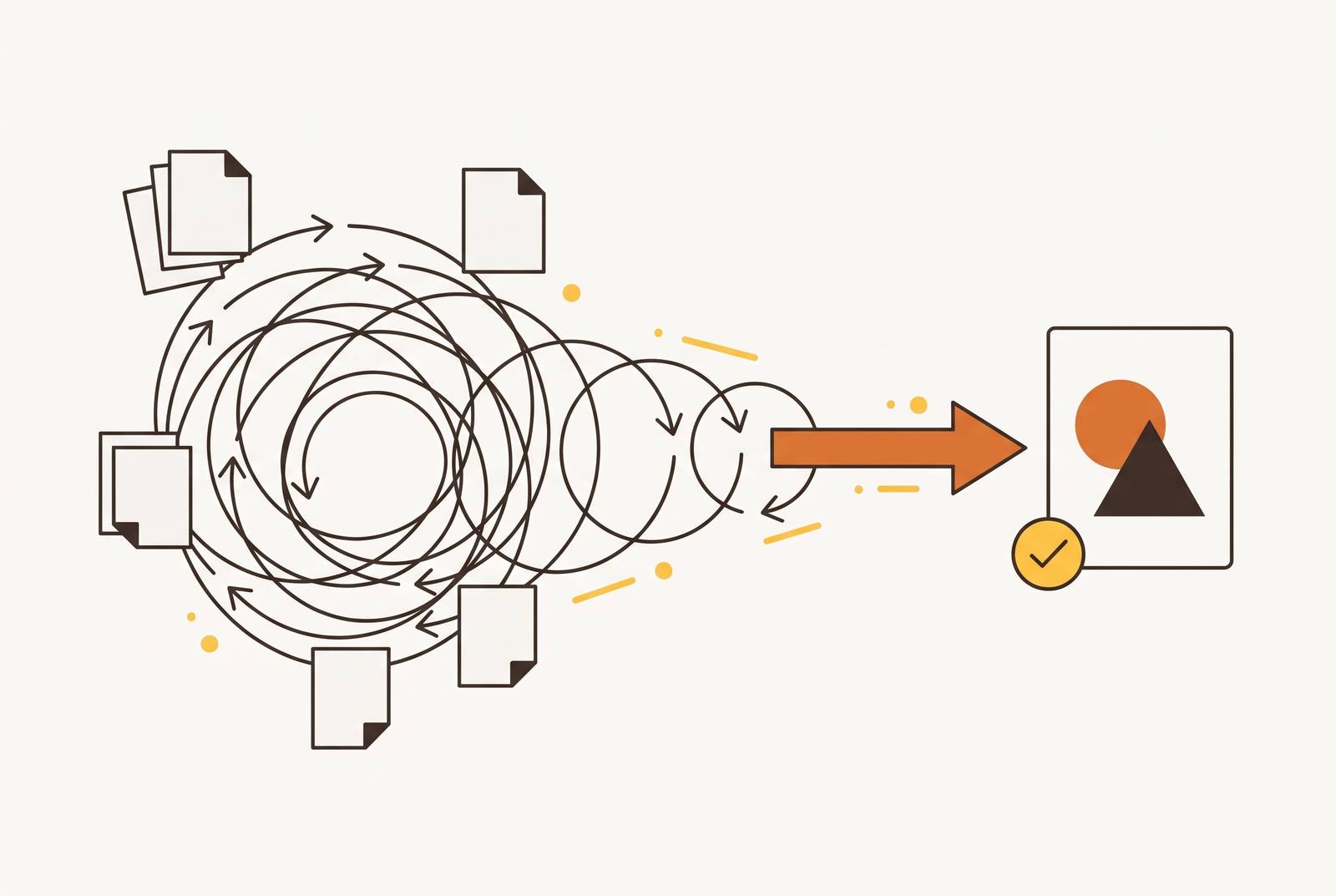
A revision round is not a referendum on how talented your creative team is. It's a measurement of how many times a piece of work had to travel back and forth between reviewer and maker before everyone agreed it was done, and when that number climbs, the cost doesn't stay contained to the one project involved. Every extra round pulls time from creative, strategy, project management, and client service all at once: the next job in the queue starts waiting, the team rushes to catch up, quality dips on the rushed work, and the client, sensing wobble, often responds by giving even more feedback. That last part is the cruel twist. A slipping process invites more scrutiny, and more scrutiny produces more rounds, and the whole thing compounds like interest on a loan nobody remembers signing.
Round count is a lagging indicator, and measuring it right turns an HR conversation about team speed into an engineering conversation about where the process is leaking.
What round count measures
Round count by itself says almost nothing. What gives it meaning is what happened inside each round: how specific the feedback was, how much rework it actually required, and whether the person giving notes had the authority to end the process. Low round count looks good on a dashboard and can still mean the work shipped worse than it should have.
Speed and efficiency get confused constantly, and they are not the same thing. A team can blast through four rounds in three days and still have burned twice the labor it needed to, because half of that work was redone from a version that had already been approved once. None of this means round count is useless. It means it needs company.
Building a measurement stack that makes round count interpretable
Three metrics, tracked together, turn a single confusing number into an actual diagnosis.
Revision cycles per project is the primary signal, and a high number is the flag that something in the workflow, somewhere, broke down. Tracking cycles per project type and per client or stakeholder group affects whether problems stay visible, because the blended number can look perfectly acceptable while one client relationship or one asset category quietly runs five rounds over budget every single time.
Time to approval catches a different failure mode.
Rework as a share of project cost is the number that speaks the language leadership actually listens to. It translates revision pain into budget terms: what percentage of hours on this project were spent redoing something that had already been built once. Running all three together lets a team answer the question that matters: did this project take too many rounds, did each round simply take too long to close, or did the team redo work it had already gotten sign-off on? Each of those three answers points to a completely different fix.
The four upstream causes that set round count before the creative team touches anything
Round count gets decided by how a team reviews and briefs work, almost never by how well the creative team executes it. Four causes explain nearly every project that drags.
Cause one is the vague note. A note that names the exact element, the exact location on the page, and the exact change wanted takes one action to resolve, full stop.
Cause two is feedback arriving in waves. Product adds three more on Thursday. Brand chimes in Friday with a logo concern nobody mentioned before. That's three separate rounds spent on a single asset, and the creative team did nothing wrong in any of them, because nobody ever asked all three groups to speak at once. The fix is structural: one feedback window, one consolidated list, with contradictions resolved by whoever owns the project before that list ever reaches the person doing the work.
Cause three is the missing approver. When five people can leave comments and none of them can actually say "approved, ship it," the project has no mechanism for ending. Comments are free to produce. Approval requires someone to put their name on a decision, and that asymmetry is why teams generate oceans of the former and almost none of the latter.
Cause four is the brand check landing last. Logo placement, typeface, color, format compliance, checked only after the creative concept has already been approved, means every brand correction becomes a brand-new round on work everyone thought was finished. That is the single most expensive kind of round there is, because it throws away sign-off that had already happened.
One project at a short-form video studio ran 19 days from brief to final cut, while another ran 4 days, using the same raw footage, the same editor, and roughly the same number of people weighing in. The 4-day version had none of those problems because the four causes above had each been closed off before the first draft even went out.
The brief as the highest-leverage intervention in the revision cycle
Most excess revision traces back to one specific failure: an aesthetic brief where nobody ever defined what the asset was supposed to accomplish strategically, leaving the creative team to guess at a purpose that was never written down.
An aesthetic brief describes a feeling, "premium," "bold," "clean," and asks the creative professional to translate that feeling into a visual without any stated functional requirement attached to it. The reviewer looks at it, senses the strategic gap without being able to name it, and responds with more subjective feedback, because the actual strategic goal was never on the page to begin with. That's a feedback loop of frustration dressed up as a design review, and it can run for rounds before anyone notices the brief itself is the broken part.
An objective-driven brief swaps the aesthetic description for four direct questions, answered before a single pixel gets touched. What does this asset need to make the viewer believe? What question does it answer, or what objection does it defuse? What should the viewer do or feel immediately after seeing it? And what's the one visual element that absolutely has to be present for any of that to work? Answer those four honestly and there's very little left to argue about in review, because the review stops being "do I like this" and becomes "does this do the job it was built for."
Singular focus sharpens the gain further. One asset, one primary objective. If two objectives genuinely both need to exist, two focused assets will beat one overloaded one nearly every time. This is the single highest-leverage fix in the entire revision cycle, because it addresses cause one before the project even has a first draft to argue about.
Brand templates and governed asset systems
A separate category of revision has nothing to do with feedback quality or brief clarity: it's brand compliance caught late, and the fix for it is structural rather than conversational, building a system where the non-compliant version was never possible to make.
A brand template, done properly, is a rule-governed asset where the brand owner has locked down exactly what can be changed and what can't: colors, typefaces, logo placement, layout grid, all fixed in advance, with only the content fields left open.
The mechanism is straightforward: when color, typeface, logo placement, and layout are locked into the template itself, the first draft that comes out of the system is already brand-compliant. The late-stage brand check described under cause four simply has nothing left to catch. The system removes the brand-compliance round. It limits judgment without removing it.
AI-powered design tools that generate fully editable, governed output extend this same logic one step further. Instead of spitting out a flat, static image that someone then has to recreate from scratch if anything needs to change, these platforms keep every element adjustable after generation. A requester who needs different copy, a swapped photo, or an updated call to action can make that change directly, without reopening a full revision round with the creative team just to move one sentence.
Where AI-assisted workflows reduce revision cycles
AI tools do cut revision cycles, in specific, identifiable places, mainly by closing the gap between a brief and a usable first draft. They do not replace the process discipline the sections above describe, and claiming otherwise would be the kind of overpromise this piece is explicitly trying to avoid.
The real gain appears early. A tool that generates an on-brand starting point, one already close to the right layout, the right tone, the right visual structure, means the first draft needs fewer corrective passes, because most revision rounds originate in the distance between what was briefed and what got made. That distance, shrunk, means several rounds simply never happen.
The honest limit appears later, in the fine-grained adjustment. Current AI tools asked for one specific change, swap this headline, nudge that color, will often regenerate the entire asset rather than touching just the one element. A tool that hands back a static image hasn't fixed the underlying delay in getting fine-grained changes made. It's just relocated it to a later stage, where it's arguably more annoying to deal with.
Architectural visualization firms offer a useful outside data point here, since their entire workflow runs on iterative client approval, round after round, by design. Missing either condition buys a faster way to generate drafts, not a smaller number of rounds to get through.
Translating round count into a recurring process improvement loop
None of this produces lasting improvement if the data just sits in a spreadsheet. Tracking round count as a KPI only pays off if what happened on this project actually changes how the next one gets briefed and reviewed, otherwise it's a scoreboard with no coaching session attached to it.
After each project wraps, the round count should get matched against the four-cause diagnostic directly. One or two rounds, on the other hand, usually means the process worked. Document what was different about this project specifically, and go replicate those exact conditions on the next one, rather than treating a clean project as luck.
One mechanism does more work here than almost anything else: writing the expected round count into the brief before the project starts, not negotiating it after rounds have already started piling up. Reviewers know the first pass needs to be complete and consolidated, not a first draft of their own thinking, and the creative team knows the second pass is the last one, not a soft suggestion. That single line in a brief changes behavior on both sides of the table before a single asset gets made.
A cultural shift matters more here than any single metric: "approved" has to be a specific, named act, not a feedback stream that just quietly tapers off until someone assumes it's done. A round closes when the named approver says it closes, not when the emails stop arriving or someone floats a new idea three days later. Anything genuinely new that is identified after approval becomes the brief for the next piece of work, not a bonus round tacked onto this one, and that one discipline alone kills off the most common form of scope creep inside any revision cycle.
Running this loop consistently brings the three metrics from the measurement stack, round count, time to approval, rework cost, into improving together rather than one at a time, because they all trace back to the same handful of upstream causes. The payoff is a team that gets measurably better at making things, project after project, because it finally has a way to see where the process broke instead of just feeling that it did.