Redesigning the Creative Brief for AI-Assisted Production
Structured briefs become the bottleneck when AI can execute directly from them.
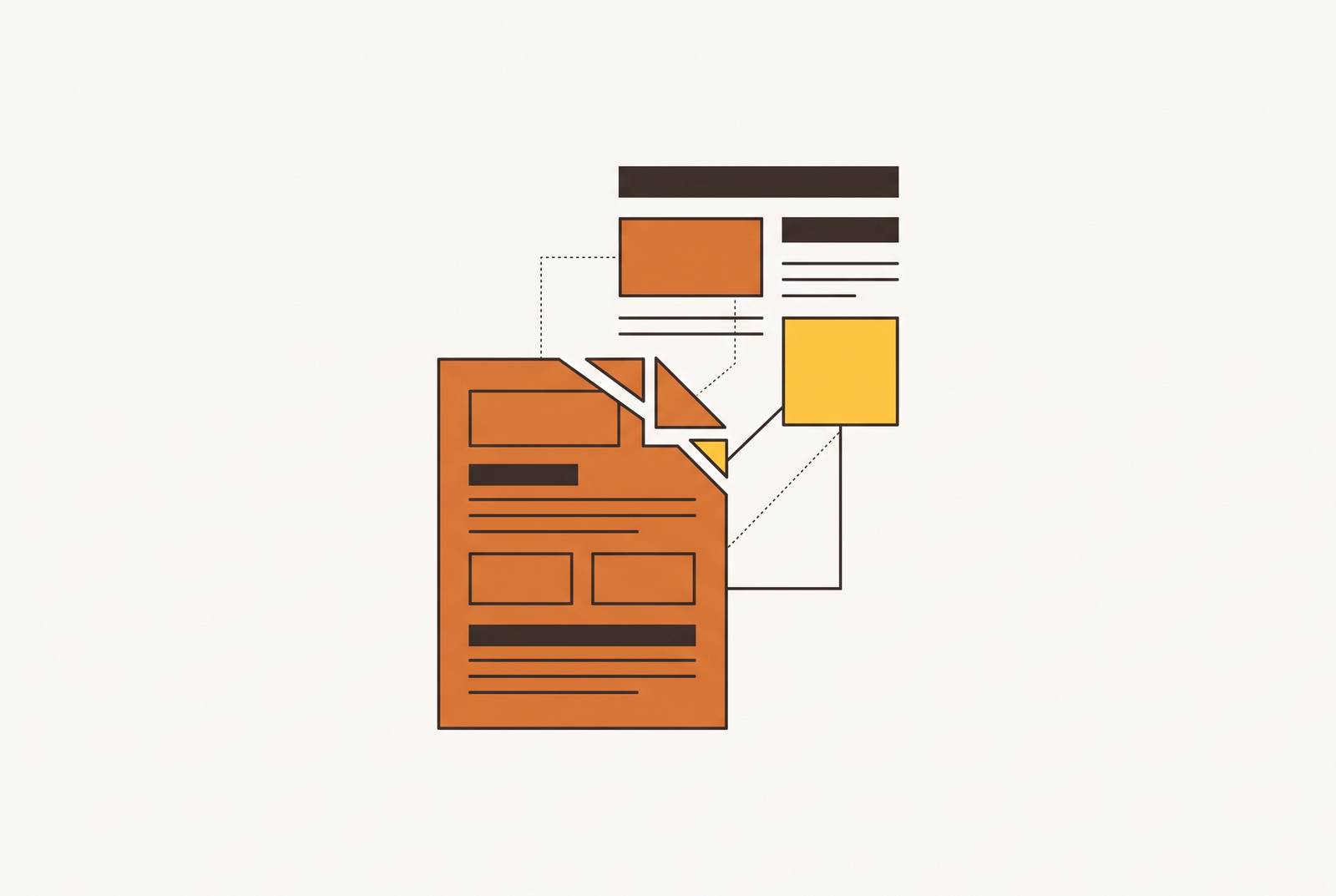
The creative brief is now the whole job, not the memo that precedes it. When AI can take a structured brief and execute it directly into a finished, editable asset, as platforms like Moda do, the quality of that brief determines the quality of everything downstream, and there's no longer a design team standing between the two to catch what's missing. That's a structural change in where the work actually happens, and it matters most for go-to-market and ops people who never had a design department to lean on.
AI does design now" undersells what changed, because the mechanism works differently. Agentic systems act differently. They take a brief, run it across multiple production steps, drafting copy, choosing layout, applying brand constraints, and hand back something a team can open, critique, and edit directly. The handoff chain didn't get faster. It got shorter.
That compression changes where human effort goes, not whether it's needed. Drafting, formatting, and adapting assets across sizes and formats move to the AI layer. Judgment hasn't been removed from the process.
Go-to-market and ops teams should recognize this immediately, even if nobody on the team has ever called themselves a designer. Every sales deck, one-pager, social post, and campaign asset a revenue team needs is reachable from a brief now, assuming the brief gets built correctly. That "assuming" is doing a lot of work, and it's the subject of everything that follows.
What the traditional creative brief was built to do
The traditional creative brief wasn't built for this. That assumption, a human reader who can infer context and fill in gaps, is baked into the format. It's also the exact assumption AI executors don't satisfy.
Part of the trouble is that "creative brief" gets used as a catch-all for three different documents that do three different jobs. Feed an AI generator the wrong type for the job, say, a content brief when what's needed is a creative brief, and the output will be wrong in a way that no amount of prompt tweaking fixes, because the document itself was never built to answer the question being asked of it.
AI executors have no fallback for ambiguity. The traditional brief assumed a human reader who could infer missing context and fill gaps, but AI executors have none of those fallbacks, so when Moda or any platform generates from an ambiguous brief, the result is a polished draft that looks ready to ship and isn't.
Most teams are currently diagnosing this problem the way they diagnosed bad early search results: get a plausible output, notice something's off, conclude the prompt needs work, try again with different words. That's the wrong fix, because the issue isn't vocabulary but structure, and structure is what the rest of this piece is actually about.
The four-stage flow that makes any AI brief safe to build on
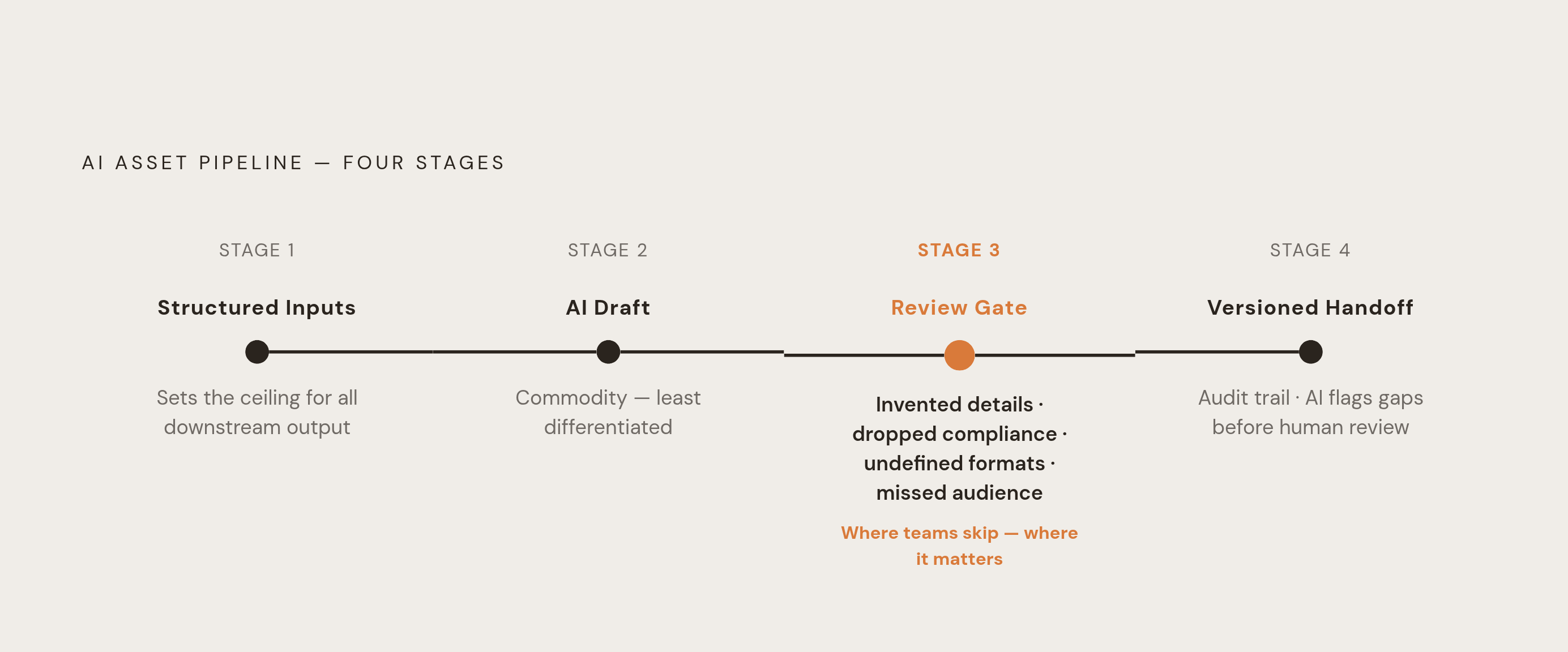
What makes an AI-generated asset safe to send into production has very little to do with which generator produced it. It comes down to a four-stage flow: structured inputs, an AI draft, a gated human review, and a versioned handoff. The generator sits in the middle of that chain, and it's genuinely the least differentiated part of the whole system.
Stage one is structured inputs. What goes into this stage sets the ceiling for everything that comes out the other end, no matter how capable the AI model is.
Stage two is the AI draft itself, and at this point it's genuinely commodity. None of those platforms is doing something proprietary enough to matter on its own; brief-drafting has become table stakes across the category, so the next two stages carry more of the real differentiation.
Stage three is the review gate, and it's the stage most teams quietly skip. The reviewer's job at this stage isn't to rewrite the brief from scratch; it's to catch the specific failure modes AI generators produce, over and over: plausible-sounding details nobody provided, compliance language that got dropped, deliverable formats left undefined, and assumptions about the audience that were never actually stated as inputs.
Stage four is the versioned handoff. AI also speeds up the checking itself at this point: a growing number of teams now run a draft brief through an AI assistant that flags what's structurally missing, an undefined KPI, an unspecified format, an absent compliance note, before the brief ever reaches a human reviewer.
What belongs in the input layer
AI is good at drafting a brief fast and checking it against a required structure. It cannot tell a team who the audience actually is, what the single most important thing to say to them is, or which business problem the asset is actually meant to solve. Those are strategic calls, and they belong at the input layer, the first of the four stages and the one that sets up everything after it.
Tone and voice need to be loaded as explicit constraints, not referenced as a PDF the AI is supposed to go read on its own. "Follow our brand guidelines" is a direction, not an instruction a generator can act on with any precision. The actual colors, the actual banned words, the actual sentence-length preferences, all of that needs to sit directly in the brief.
There's a parallel shift for visual generation: a better use of AI here is to ask for breadth, many directions, many layout options, a fast synthesis of reference images, treating every one of those results as raw material for a human to choose from. The brief's job in visual work shifts from describing the final image to defining the space of acceptable answers, and the human picks from inside that space.
This narrows the gap but doesn't close it. Framing the problem correctly, getting a genuine audience insight validated with actual stakeholders, owning the outcome when an asset misses its mark, these stay human jobs no matter how well-built the brief is. A brief can route judgment efficiently. It can't manufacture judgment that wasn't there to begin with.
Applying brief structure to the assets go-to-market teams produce most
The four-stage flow holds across asset types, but each type breaks in its own particular way, and knowing the specific failure mode is what makes a brief specific enough to actually be useful.
Sales and leadership decks fail most often on invented statistics. Platforms that produce fully editable output on a real canvas, Moda among them, let a team act on a brief-generated structure while keeping the ability to adjust any individual element before the deck actually leaves the building.
One-pagers have a quieter failure mode: they get briefed as a request for permission when they should be briefed as a report of work already done. That one reframe changes the entire document structure an AI produces, moving it from context-ask-rationale-appendix toward problem-system-results-recommendation. The brief also needs to specify how the document gets read: alone, cold, or as a follow-up after a meeting already happened. That single variable changes what the opening section has to accomplish, and it's a detail that's easy to leave out and expensive to leave out.
Social content runs into format omissions more than any other asset type. ChatGPT Images 2.0 plans a layout before it renders anything and handles text inside images noticeably better than earlier models, short headlines and labels render reliably, though longer body copy still breaks. That means the brief needs less pixel-level description of what the image should look like and more clarity on layout intent and which piece of copy is supposed to read first.
Brand and visual systems are their own category. Teams that need visual consistency across markets can train Adobe Firefly on their own brand assets so outputs start closer to the house look by default, which shifts the brief's job from describing the brand from scratch to defining what the model is actually allowed to vary. For vector work, logos, icon sets, anything that needs to scale cleanly, Recraft generates production-ready SVG files directly, which matters because a logo has to hold its edges at billboard size and at favicon size, and the brief needs to list that output format as a hard requirement. The brief doesn't need to be perfect if the output underneath it stays editable.
How brief structure prevents brand drift
Once AI-assisted production scales past one person, the brief itself becomes the main thing holding brand consistency together. The alternative, every team member prompting independently with their own sense of tone and layout, produces a pile of assets that technically all came from the same company and don't look like it.
There's a concrete version of this happening already. The tool's capability isn't what makes that possible. The brief structure embedded in its inputs is.
A workable brief architecture for team-scale consistency has two layers and a checkpoint. And a review checkpoint separates assets that can ship after one quick human check from assets, customer-facing, legally sensitive, executive-level, that need something more formal before they go out.
The honest objection deserves a real answer rather than a dismissal: giving more people the ability to produce assets doesn't automatically give them the judgment to know which output is actually good. The realistic outcome isn't the disappearance of design expertise, it's leaner in-house teams working with AI-native tools, where fewer specialists cover more ground because the brief does some of the judgment work for them. A brief's locked sections encode judgment a non-designer doesn't have into the template, so a single designer or design lead can govern a team's output without personally reviewing every file. Platforms like Moda, built with go-to-market teams and non-designers in mind, operationalize this by letting a design lead set up brand-consistent templates that teammates use without needing to understand the design reasoning sitting underneath them.
Replacing ad hoc prompting with a brief-driven workflow the whole team can use
The teams getting real gains from AI-assisted production rebuilt their workflow around brief architecture, built review into it by default, and kept a clear line around which decisions still need a human to make the call.
In practice, that looks like a small, purpose-built set of pieces working together. And a version log keeps the approved brief paired with the output it produced, which builds an audit trail and, over time, a working record of what actually performs.
Something changes about where creative leadership sits once this is running. Every AI tool in this wave executes off a description, so the strategic thinking that used to stretch across a week of concepting meetings now has to happen at the point the brief gets written. The creative lead's actual job has simply moved earlier, now applied at the input stage instead of hovering over the review stage waiting to catch mistakes.
For a team starting from nothing, the instinct to test five tools at once is the wrong instinct. A full solution to one real problem compounds over time. A shallow test across five problems doesn't, because nothing gets built deep enough to actually hold.
The forgiveness built into this system means a near-miss brief doesn't sink the work. Platforms like Moda, which return every output as a living, editable design instead of a flat image or a locked export, make a brief-driven workflow survivable even when the brief wasn't quite right the first time. A near-miss brief paired with a static export means starting over or sending a revision request into an agency queue. A near-miss brief paired with a real, editable canvas means the team just fixes it. That difference is most of why brief quality, not generator choice, is the variable actually worth obsessing over, and each brief that lands well teaches the team something about how to write the next one better.