How Unclear Creative Briefs Multiply Designer Rework
Vague briefs trigger cascading revisions that compound design rework costs.
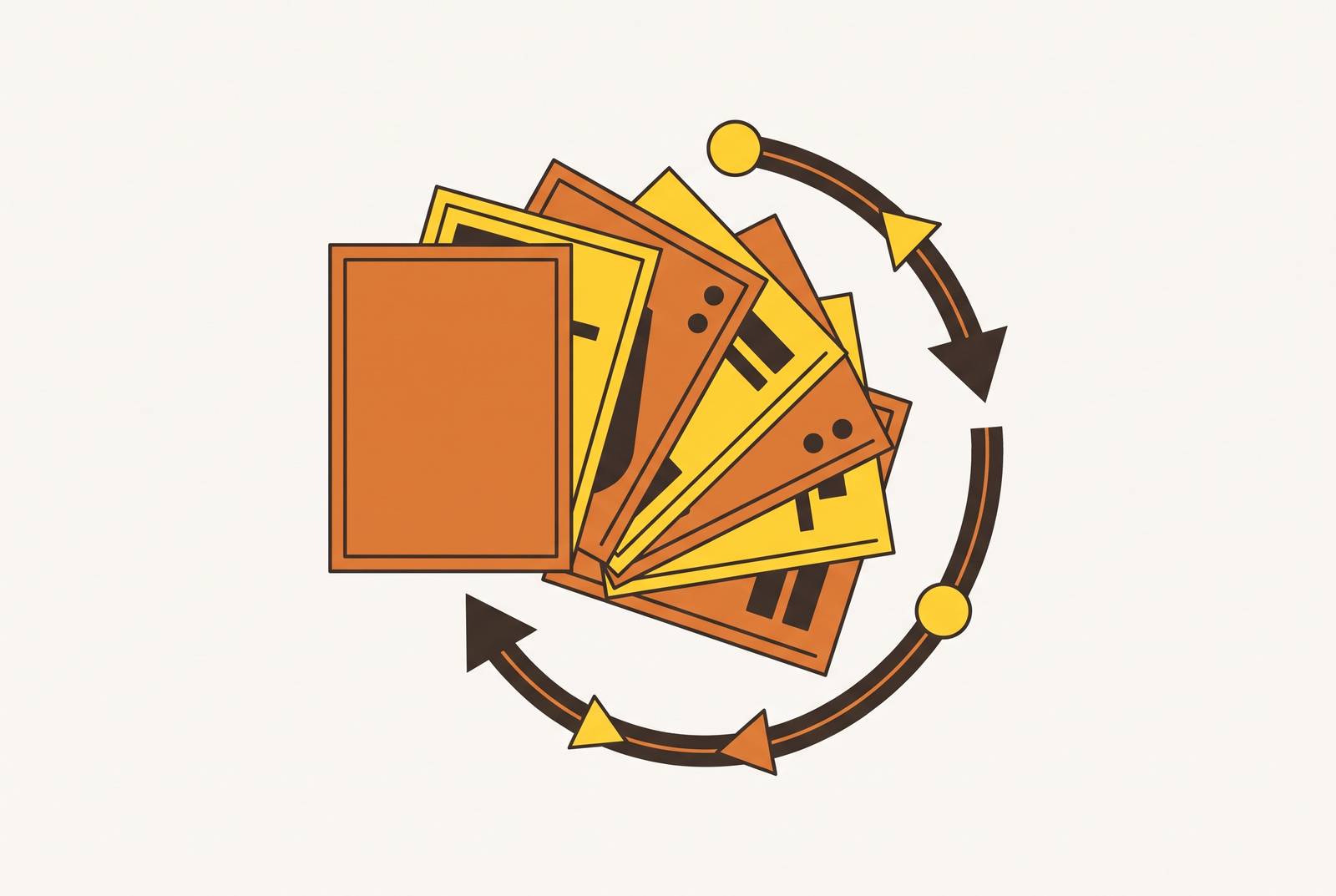
An unclear creative brief does not cost a team one clumsy revision and then quietly fix itself. It sets off a chain reaction: each vague instruction produces a guess, each guess gets built and reviewed and rejected, and each rejection becomes the flawed foundation for the next attempt. That is the mechanism this piece traces, from the first misaligned draft through to the moment AI tools enter the workflow and, rather than solving the problem, start making the same mistakes at higher speed.
Why vague briefs don't just cause one extra round, they trigger a compounding cycle
The multiplier effect: revision 1 wastes hours; revision 2 wastes more because the team is now correcting both the original misalignment and the first correction; revision 3 often requires discarding work entirely. Neat, contained, forgivable. The actual pattern looks nothing like that.
Revision one wastes a handful of hours. Revision two wastes more because the team is now correcting two things at once: the original misalignment and whatever assumptions got baked into the first fix. By revision three, the work often has to be thrown out entirely, because the creative direction itself was contaminated from the start and no amount of polishing saves it. Rework.com's research on creative brief development puts a number on the alternative: projects that start with a clear brief are three times more likely to land on the first or second round of feedback Creative Brief Development / Rework. When that statistic is reversed, it becomes the premise of everything that follows here: teams without that clarity are not just slower, they are structurally set up to guess wrong, repeatedly, in ways that stack.
This is not a story about bad designers or difficult clients. It is a production problem, sitting upstream of both.
The scope and limits of a brief missing key information
A brief, properly built, does four jobs. Asana and Shopify's respective guides converge on roughly the same list. It creates alignment before anyone touches a design tool, so a client does not approve a concept "in principle" and then reject the execution because they pictured something entirely different. It provides focus, drawing a line around what the project is and, just as importantly, what it is not: a campaign built for millennial parents is not also, quietly, a campaign for Gen Z singles. It gives creative direction without dictating the output: telling someone to "speak to empty nesters downsizing for the first time" versus telling them to "use warm colors and show happy people." And it sets success criteria before the work starts, not after delivery, so nobody is grading the project against a goalpost that moved.
Who actually writes the thing affects how well the brief functions. Shopify's guidance is that the person closest to the project, the business owner or the marketing lead, should draft it; when an outside agency is involved, the agency's strategist typically takes the pen. The best results tend to come from something collaborative, business context married to design expertise, rather than one side handing a document over the wall to the other.
There is also a timing problem that gets underrated. A brief written mid-project, after work has already started, almost never catches up to the momentum already built. It tends to generate rework rather than prevent it. The brief has to exist before the project gets assigned to anyone. And length matters more than it should: the effective range is between one and three pages. Shorter than that and critical information gets left out. Longer, and the document becomes a thing nobody actually reads, which defeats the entire point of writing it.
The specific failure modes that turn a brief into a rework generator
Two failure modes sit at opposite ends of the spectrum, and both produce the same rework. One is the brief that says "make something that pops," which hands the designer an aesthetic to guess at instead of a problem to solve. The other overcorrects: "use exactly Pantone 286 C and no other blue," a level of prescription that strangles creative judgment and produces work that is technically compliant and strategically useless. Neither extreme works, and the fact that both fail for opposite reasons is a decent clue that the answer sits somewhere in the specificity of the problem statement, not in how many constraints get piled on top of it.
Conflicting objectives cause a quieter version of the same failure. A client who wants awareness, leads, and loyalty all at once is asking for three different strategies stapled together, and a brief that does not force a single primary objective just defers that fight to the review stage, where it costs far more to resolve Creative Brief Development / Rework.
It typically takes around 5 rounds of creative development to reach a signed-off idea. Without a written, centralized brief, every team member fills the gaps with their own assumptions. The designer pictures one audience, the copywriter pictures another, the account lead is quietly working toward a third, and all three of them are doing perfectly competent work toward completely different targets Creative Brief Development / Rework. Scope ambiguity does the same thing from a different angle: without a clear deliverables list, there is no neutral document to point to when a stakeholder asks for "just one more thing," which means scope creep is not really a client personality trait. It is what happens by default when the brief never drew a line in the first place.
And then the blame cycle kicks in, predictable as weather. The creative team blames the account team for unclear direction. The account team blames the client for changing their mind mid-project. The client blames everyone for not reading their mind, which, to be fair, nobody can do, brief or no brief. Rework.com frames this as preventable, which is the more useful way to think about it: not an inevitable feature of creative work, but a symptom of a document that was never built to hold up under pressure.
What each rework round costs in time and money
Revue's creative brief cost guide lays out the mechanism: designers, copywriters, and strategists spend more hours asking questions, guessing, and redoing work than they spend actually creating it, and that time is not billable, but somebody is still paying for it. Every revision cycle adds labor cost, and a campaign that has to be scrapped and rebuilt from zero racks up a bill Revue describes flatly as astronomical.
Put numbers to it. A logo refresh that sounds simple on a kickoff call can run 40 to 80 hours once revisions get counted, and without a scope cap built into the brief, that number surprises clients almost every time.
Even in a reasonably well-run process, monday.com cites the BetterIdeas Project's finding that it typically takes around five rounds of creative development to land on a signed-off idea. Five rounds. That is the baseline, the number teams hit with some process in place. A vague brief does not add one round on top of that; it pushes the whole cycle toward the upper end of that range or past it entirely.
The costs that do not show up on an invoice matter just as much. Revue frames client frustration as a relationship cost, not just a labor one, the kind that erodes trust and quietly costs future business long after the immediate project wraps. A vague brief at the scoping stage and a vague quote at the pricing stage tend to arrive together, and each one makes the other more expensive. How many of those five rounds are actually necessary creative refinement, and how many are just the brief catching up to itself? Agency rate context is drawn from ManyPixels' 2026 design agency pricing guide. According to Many Pixels, a Junior designer costs $75–$150/hr, a Senior designer costs $150–$300/hr, and a Creative or strategy director costs $250–$500/hr. According to Many Pixels, large branding or website projects at traditional agencies often exceed $50,000–$150,000, and scope changes at these levels trigger additional fees on top of already significant commitments.
How AI workflows amplify the brief-quality problem rather than solving it
AI-assisted design is not a niche behavior anymore. McKinsey's State of AI survey, cited by cflowapps.com, put regular AI use at 88% of organizations in at least one business function. That is close enough to universal that the interesting question is not whether teams use AI, but what happens when they feed it the same vague brief that used to just slow down a human designer.
Telerik's AI design and development workflows report found that 69% of practitioners say AI has helped their workflow and productivity Telerik AI Design Development Workflows Report. But that help speeds up tasks within a single role, not the friction that happens between roles, which is exactly where brief-quality problems live. And the same report found that 36% of designers say AI output does not align with their design system standards⟧, which is the identical failure mode a vague human brief produces, just wearing a different hat Telerik AI Design Development Workflows Report. Bad direction in, bad output out, regardless of whether the thing executing the direction has a pulse.
Worklytics' 2025 analysis of generative AI and workforce productivity puts the dynamic in blunter terms: AI amplifies whatever process quality already exists. Strong processes plus AI multiply effectiveness. Weak briefs plus AI just produce the same misalignment faster, at machine speed, generating more corrections rather than fewer. A vague brief fed into an AI workflow does not politely cap itself at three rounds of rework the way a human team might. It can spiral into far more iterations than that, each one needing a human to review it, catch what is wrong, and correct it, all before anyone steps back and notices the direction was off from the very first prompt.
The upside brings productivity gains, but only within a clearly defined enterprise design system. A controlled experiment run between 2024 and 2025 found that when AI support operated inside a clearly defined enterprise design system, productivity gains ran from 46.7% on iOS projects up to 69.4% on Angular and 57.9% on Android Controlled experiment (arXiv). Those are not small numbers. But they depend entirely on the clarity of the system the AI is working inside. Without that clarity, the condition that makes the gain possible disappears with it. AI does not fix a vague brief. It just executes the vagueness faster.
What a brief must contain to prevent rework at each stage
So what actually stops the cycle? Synthesizing guidance from Shopify, Asana, and ziflow.com, a handful of components consistently correspond to specific failure modes. A project overview answers what the deliverable actually is and what problem it solves, closing the gap where designers infer the wrong output type entirely. A single primary objective heads off conflicting stakeholder goals before they start: if three stakeholders each want awareness, leads, and loyalty, the brief is where that argument happens, not the review call. A specific audience description, demographic and psychographic both, replaces "millennial parents" with actual texture instead of leaving "happy people" to a designer's imagination. Design requirements and brand constraints set the boundaries of the playing field without dictating what happens inside it. Named stakeholders with defined approval authority stop timeline confusion that has nothing to do with the quality of the creative work itself. A real budget and a real due date, not aspirational ranges, keep scope conversations tethered to something concrete. And success criteria, agreed before work starts, mean nobody is retrofitting a definition of "good" after the fact.
Shopify's guide quotes entrepreneur John Cascarano relaying a line he once heard: "Give me the freedom of a well-defined creative brief". That framing inverts how most people think about constraints. A brief that spells things out clearly is not a cage. It is the fence that lets someone run without worrying about the edge of the field.
How templates and structured design systems keep brief quality consistent across a team
Templates solve a problem that individual good intentions cannot: consistency across people who will never all have the same instincts. Monday.com's guide on creative brief templates notes that when marketing, design, product, and leadership teams all work from the same format, everyone can find the information relevant to their role fast, no one is digging through paragraph four to find the actual objective. That also builds in a defense against scope creep, because a documented, agreed-upon list of deliverables becomes the reference point when a request exceeds what was scoped, turning a subjective argument into a straightforward budget or timeline conversation.
Design systems function as the visual counterpart to the brief. Where the brief defines what the project is trying to accomplish, the design system defines what "on brand" actually looks like, and pairing the two removes two separate sources of revision-triggering ambiguity in one move.
This matters more now than it used to, because the population creating branded material has changed. Grafisify's 2026 overview of AI design tools points out that founders, freelancers, salespeople, and operators are now producing branded assets directly, not trained designers. That group does not carry the professional instinct to ask the right alignment questions before starting, the kind of muscle memory a design department builds over years. Structured templates matter more for exactly that reason, not less. Without the infrastructure, brief quality becomes personality-dependent: the account lead who happens to ask good questions produces a good brief, the one who doesn't produces a rework cycle, and neither outcome scales.
Tooling that supports brief-driven design workflows for non-designer teams
The tooling market has noticed the same shift. Grafisify's 2026 overview describes AI design tools as a major battleground now, with Google positioning itself as a contender at Google IO 2026 and Microsoft and Adobe competing for the same audience: people who need decent design output but lack the training or the hours to produce it by hand.
The distinction that actually matters is editability. Tools that generate a locked, static image are the visual version of a brief nobody can revise: a starting point with no mechanism for correction. Tools that produce a genuinely editable canvas, where every element can be adjusted against the brief's brand requirements and messaging constraints, are where brief clarity actually pays off, because a wrong detail gets fixed instead of the whole thing getting regenerated from nothing.
On the presentation side specifically, PowerPoint's Copilot integration generates slides, suggests designs, and summarizes content, priced at $21 a month per user for organizations under 300 seats (down from $30 as of December 1, 2025) or $30 for enterprise accounts. Google Slides added Gemini integration in 2024, generating content and layout suggestions, though it is generally regarded as less sophisticated than tools built specifically for the job.
For go-to-market teams producing sales decks, one-pagers, social posts, and case studies across many different authors, brand consistency is the whole game, and superside.com's analysis frames the winning combination as sharp creative judgment paired with AI that actually understands the brand, running on a workflow that moves without drama. The brief is the input that makes any of that possible. But predictable pricing does not exempt anyone from the underlying rule. Every one of these tools, cheap or expensive, fast or slow, still runs on the quality of the brief someone hands it, and none of them can guess correctly on a team's behalf. Presentation-specific tooling includes confirmed 2025–2026 products. Per ManyPixels' pricing guide, subscription design services typically cost $699–$2,599/month (more predictable than agency retainers ($3,000–$15,000+/month)), but still external, still dependent on briefing quality.
Sources
- Design Agency Pricing: Rates, Models & What to Budget (2026)
- Creative Brief Development: Foundation for Effective Creative Work and Client Alignment
- Creative Brief Components + Best Practices for Writing Briefs (2025) - Shopify
- Creative Brief Cost Guide: Investing in Project Success | Revue
- The creative brief: key components, how to write and template
- Creative Briefs: What To Include (with Template) [2026] • Asana
- Workflows in the Age of AI - What Changed in 2025 and 2026
- Creative brief template: a step-by-step guide to project alignment