Brand Asset Scattering and Its Cost to Creative Output Speed
Scattered brand assets drain design teams into file-hunting instead of creative work.

The symptom appears in Slack. Someone asks whether there's a white version of the logo. Someone else wants to know which deck is the current one, because there are four files named "final" in the shared drive and none of them are. When that is multiplied by every team touching brand materials, a design department stops doing design and starts doing customer support for its own company.
The cause is less dramatic than the effect. Assets scatter because storage follows the org chart, not the brand. A shared drive fragments by project. Email becomes a delivery mechanism, which means the "official" version of a logo might be sitting in a thread from March, attached to a message titled "quick favor." Personal desktops turn into accidental archives, the kind nobody remembers exists until the person who built them changes teams.
What follows from that is predictable, and not in a good way. Creative staff spend real hours on non-creative overhead: tracking down files, confirming they have the right version, and fixing branding errors after the wrong file went out anyway. None of that is creative work. It's filing, except the filing cabinet is on fire and everyone keeps asking where the good folders went.
The riskier part is what teams do when the right asset is hard to find. They use whatever they can find instead. Findability, not approval status, ends up deciding what gets used, which means outdated logos, retired taglines, and last quarter's pricing chart keep circulating simply because they're easier to grab than the current version buried three folders deep.
The volume math that makes scattered assets a structural drag
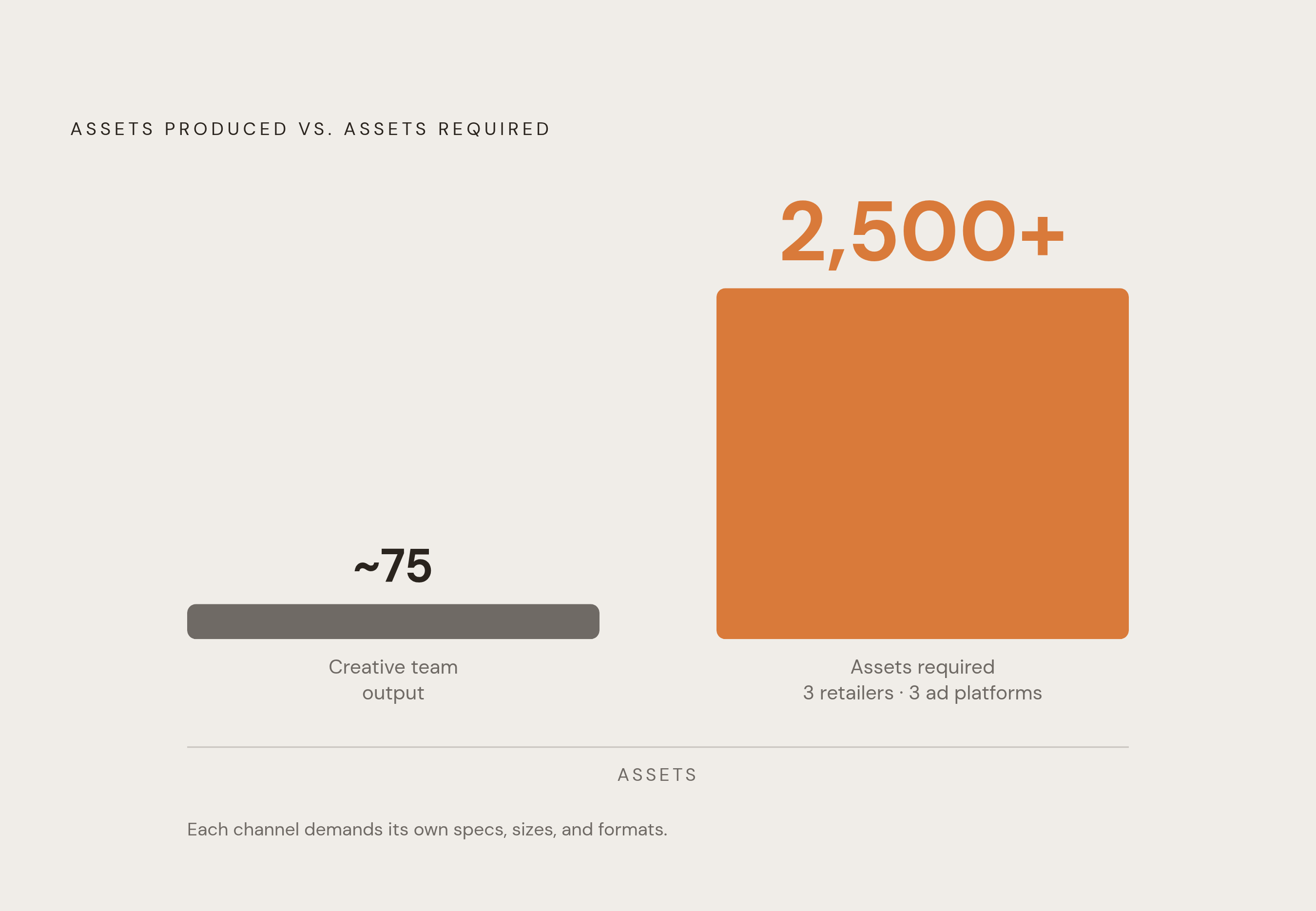
Most creative teams produce somewhere around 50 to 100 assets in a normal stretch of work. A brand with just a handful of product lines, selling across three major retailers and running ads on three platforms, needs upward of 2,500 assets to cover the specs, sizes, and formats each channel demands.
The gap is not small, and it is not even the same order of magnitude. It's not even the same order of magnitude. And it matters because the instinct is to read it as a productivity problem, something a faster designer or a longer workweek could close. It can't close the gap, because the team isn't slow, the system is undersized for what's being asked of it, the way a two-lane road doesn't get less congested just because the drivers are skilled. The team isn't slow, the system is undersized for what's being asked of it, the way a two-lane road doesn't get less congested just because the drivers are skilled.
Three forces widen that gap every year, and none of them are under a creative team's control. Retail media networks and ad platforms keep adding formats and size specs, so every new channel multiplies the asset count rather than adding to it in a straight line. Platform algorithms reward freshness, and brands that refresh creative more frequently tend to outperform ones on slower cycles, but most teams can't even hit quarterly because they're still working through last month's backlog. And every hour lost to hunting for a file or fixing a branding error is an hour not spent making anything new, which means the retrieval tax doesn't just cost time, it compounds as volume grows.
The scale version of this problem has a real anchor. One Amazon team of 25 people produces 250,000 assets. That figure isn't a headcount story, it's a systems story: nobody staffs their way to a per-person asset count that high. Something in the pipeline itself has to change.
What "hidden tax" means in time and money
Call it a tax because it behaves like one: unavoidable, recurring, and easy to underestimate until someone adds up a year of it. Every unanswered asset request, every approval cycle that restarts because the wrong file went out the door, every correction made after a client or customer already saw the mistake, these aren't edge cases. They're line items that recur every week, whether or not anyone's tracking them.
Agencies are the usual workaround, and they come with their own ceiling. A typical creative agency charges somewhere between $75 and $150 per static asset resize, with turnaround measured in business days, often ten of them. At a volume of 200 assets, that runs between $15,000 and $30,000 in fees, and that's before any actual strategy or concepting happens. Ten-day turnarounds also make rapid testing close to impossible; by the time a batch of ad variants comes back, the campaign it was meant for has often already run.
Hiring in-house doesn't sidestep the math either. The median salary for a US graphic or UX designer runs $95,000 to $115,000, but that's the sticker price, not the real one. Once benefits, taxes, equipment, and onboarding are added, the true first-year cost is somewhere between $130,000 and $230,000.
The dynamic compounds in a way that's easy to miss. Agency fees might buy volume, but they don't buy speed. And an in-house hire doesn't fix speed either, not if the underlying asset system is still scattered across five drives and a Slack archive. The retrieval tax doesn't care who's doing the retrieving.
How brand inconsistency spreads when assets are ungoverned
Without one governed source of truth, people use what they can find. That sentence sounds obvious written down, but it's the entire mechanism behind why brand inconsistency spreads, and it explains why "we have a brand kit" is often not the same thing as "we have brand consistency."
A brand kit, colors and fonts locked into a style guide, handles the surface level fine. What it can't enforce is claim hierarchy (which message goes first), tone by market (how a brand sounds in one country versus how it sounds in one region), or the visual rules that separate a social ad from a product one-pager. At low volume, a designer catches those gaps by hand, correcting them the way a copy editor catches a typo. At high volume, nobody's reading every asset before it ships, and the gaps compound instead of getting caught.
Multi-location brands hit a geographic version of the same failure. As a company scales across offices, regions, or franchise locations, a shared drive folder becomes the weak point: the wrong file goes out, someone makes an unauthorized edit, an outdated flyer reaches a client because it was sitting at the top of the folder. The scattering is no longer just organizational; growth across locations makes it geographic too.
One well-documented contrast comes from Salesforce. Rather than relying on individual discipline to keep hundreds of people on-brand, customizable, brand-approved templates let its social media team edit and post content in a few clicks. The system did the governing. Nobody had to remember the rules, because the rules were baked into the template itself.
The limits of more files, more people, and more folders
The first instinct is usually a better folder structure. Reorganize the shared drive, name things consistently, build a taxonomy. It helps for about a quarter. Then a new hire joins, a new campaign launches, a new product line ships, and the scatter regenerates faster than anyone can maintain the filing system that was supposed to fix it.
The second instinct is headcount. Add a designer. But a structural gap doesn't close because one more person joined the team standing in the gap. If the existing team is already spending a meaningful chunk of its week on retrieval and correction, the new hire inherits that same overhead on day one, and the team's overall output per person barely moves.
The third instinct is an agency retainer, which trades an hourly nightmare for a flat monthly one, though that cost varies widely depending on company size and scope. That buys predictability and a wider range of skills than most in-house teams have on staff. What it doesn't buy is self-service. Every asset still requires a request, a handoff, and a wait, which means the help-desk dynamic from the first section never actually goes away, it just moves to a different inbox.
All three fixes share the same blind spot. They treat capacity, skill, or organization as the problem, when the actual cause is that assets and the tools to produce with them aren't connected to the people who need them. Fix the connection, and the folder structure stops mattering nearly as much.
What a governed asset system looks like in practice
A governed system runs on three connected layers, and skipping any one of them tends to recreate the original problem in a new outfit.
The first layer is a digital asset management platform, a DAM, which stores and governs the approved files. It's the single source of truth that replaces the shared drive, the inbox, and the desktop archive all at once. Vendors in this space include one platform, which runs natively on a major cloud provider and is recognized in Gartner's 2025 Magic Quadrant for Digital Asset Management, and another vendor named a Visionary in the same Gartner research. Canto and Bynder appear in that research too.
The second layer is a brand portal, which presents those assets with context: not just the file, but the guidelines for when and how to use it. And the third layer is content creation tooling that lets teams outside the design department actually produce on-brand materials, rather than routing every request back through a central team. Marq, for instance, activates stored assets through locked, brand-safe templates, letting non-designers create finished content while the design team keeps control over the guardrails.
That third layer is easy to underrate. A DAM solves retrieval. It answers "where is the file." It does not answer "how does someone who isn't a designer turn that file into a finished, on-brand asset," and without that second piece, a company has just built a very well-organized filing cabinet.
The results from systems that connect all three layers are worth the specificity. Colgate delivers transcreated assets across seven countries in under two days. eXp Realty agents localize content into 14 languages within hours. Neither of those numbers happens through better folder names.
AI-assisted production and the gap between asset access and asset output
The shift AI enables is subtle but important: moving from "anyone can find the right asset" to "anyone can produce a correct, on-brand asset," without a designer touching it first. Finding the file was never really the hard part. Making something usable out of it was.
The productivity numbers back this up. 89% of designers report working faster with AI folded into their workflow, and AI-assisted professionals complete tasks 25% to 56% faster, saving something in the neighborhood of 3.5 hours. A 2025 survey cited by the American Marketing Association found 85% of marketers using generative AI report increased productivity, and roughly half say AI improved both the quality and the quantity of their creative output.
None of that solves brand consistency on its own, though: a language model doesn't know a company's claim hierarchy or its tone-by-market rules unless something else enforces them. AI is very good at generating volume. Left ungoverned, it's just as good at generating inconsistency at volume, because a language model doesn't know a company's claim hierarchy or its tone-by-market rules unless something else enforces them. The first place things break down when AI production scales without a template layer underneath it is brand consistency, for the same reason a brand kit alone couldn't hold at scale in an earlier section: rules that live in a document don't travel with the output automatically, because nothing forces them to.
Giving non-designers the ability to self-serve without breaking the brand
The assumption that's been quietly running under every bottleneck in this piece is that brand consistency requires a designer to touch every single output. Question that assumption directly, and the help-desk dynamic from the opening section starts to look less like an inevitable cost of doing business and more like a design choice that can be undone.
Locked, brand-safe templates are the mechanism that undoes it. Sales, marketing, operations, regional offices, all of them can produce materials inside approved guardrails without a design ticket in the queue. The designer's job doesn't disappear in this setup, it moves upstream: instead of producing the asset, the designer builds the system that governs how the asset gets produced by someone else.
What that changes operationally is fairly concrete. A sales rep can put together a tailored one-pager or pitch deck without waiting on a design queue that's three days deep. A regional office can localize a campaign asset for its market without accidentally creating an off-brand variant that spreads the way the franchise scattering described earlier did. And marketing can refresh ad creative on the cadence platforms actually reward, brands running more creative variants regularly outperform those on slower refresh cycles, extending campaign performance meaningfully.
The designer's role in that system is setting up the templates, the brand rules, the guardrails, so that a teammate in sales never has to open a professional design tool to get something usable. That's a higher-leverage use of a designer's time than answering "do we have a white logo" for the fortieth time this quarter.
Four metrics that tell you whether the system is working
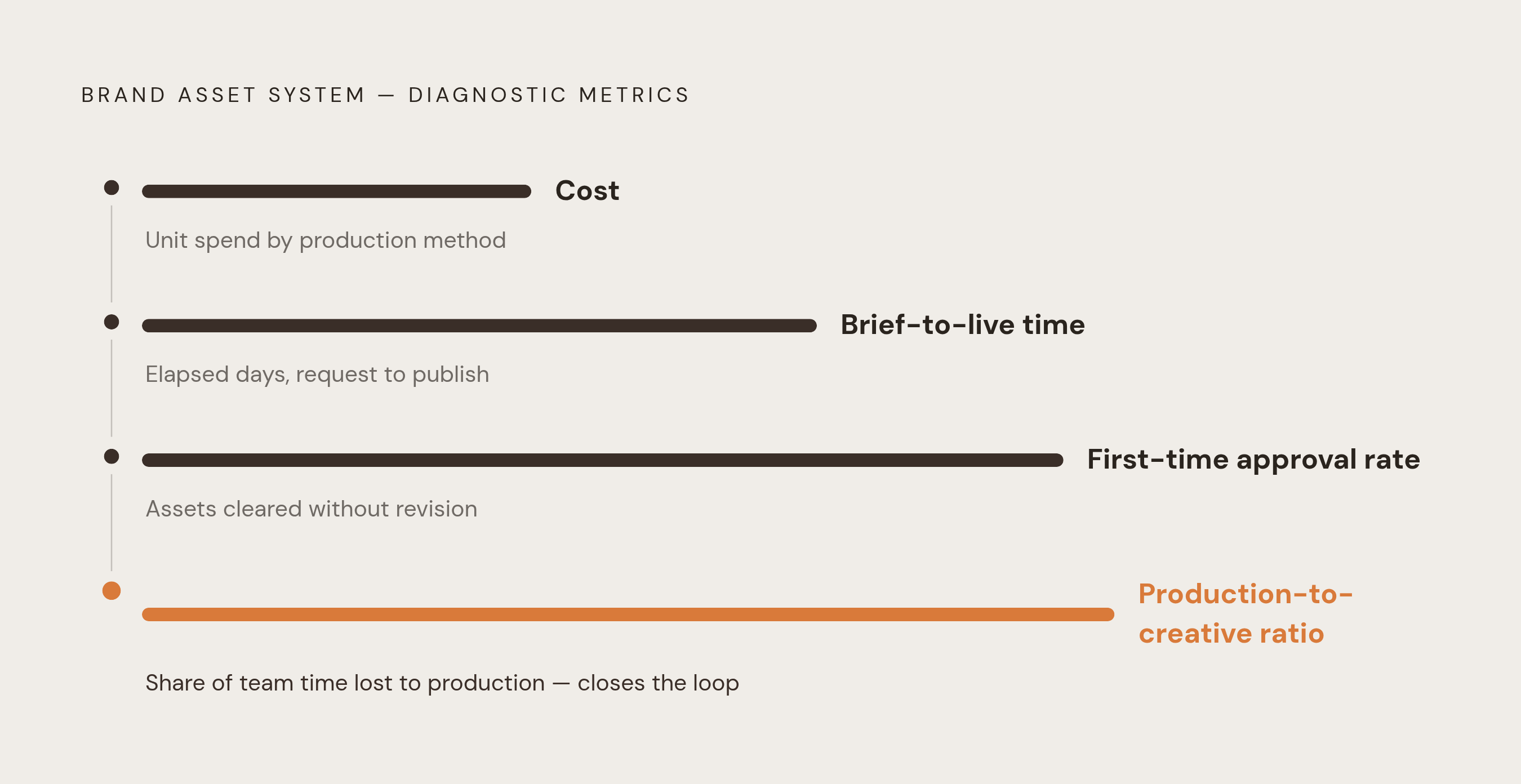
Rocketium's 2026 scaling playbook names four metrics, and each one catches a different way a system can quietly fail even after it's been "fixed" on paper.
Cost tracks whether production is sustainable at the unit level. Understanding the unit cost of each production method matters: the gap between AI-assisted output and traditional studio work can be substantial. That's not an argument that one replaces the other everywhere; it's a benchmark for knowing which one you're paying for at any given moment.
Brief-to-live time measures the interval between a request landing and an asset going out the door. This is where the retrieval tax from earlier in the piece becomes most visible, and it's usually where a governed system produces the most obvious, measurable gain. First-time approval rate tracks what percentage of assets clear review without a revision cycle. A low rate here signals that the template layer isn't enforcing brand rules the way it's supposed to, no matter how good the DAM looks on paper.
Production-to-creative ratio is the one that closes the loop on the whole piece. It measures how much of a team's time goes to production tasks versus strategic and creative work. If designers are still fielding "which version is current" messages in Slack, the ratio hasn't moved, and neither has the underlying problem this piece opened with.
Tracking all four together reveals a pattern that a single metric would hide. Cost and brief-to-live time catch delay. First-time approval catches brand drift before it spreads the way it did in the franchise example. And production-to-creative ratio catches the help-desk dynamic directly, the one this piece started with and has been circling back to the entire way through. A team watching all four has stopped treating scattered assets as a filing inconvenience and started treating it as what it actually is: a production velocity problem, measured the way velocity should be, in time, cost, and how often the work is right the first time.