AI Design Tools That Replace Agency Retainers for Startups
AI tools now handle routine design work agencies charged retainers for.
The Shifting Economics of the Retainer Model
Startups are ditching design retainers, and it's not because agencies got worse. AI tools now cover most of what a retainer used to bill for: slides, social graphics, one-pagers, landing pages, ad creatives, brand asset updates. Most of these tools only pay off if the output is fully editable by someone who's never touched a design program in their life.
For years, startups paid retainers because there was no other option. No in-house designer, no way to keep a logo and color palette consistent across ten formats, no way to get an asset back same-day instead of next week. The retainer never really billed for artwork. It billed for labor hours, agency overhead, creative direction meetings, and revision cycles. Every request carried a kind of tax: time spent writing the brief, time waiting in the queue, time reviewing drafts, time routing approvals. Clients paid that tax because building an in-house team cost more. That math just flipped.
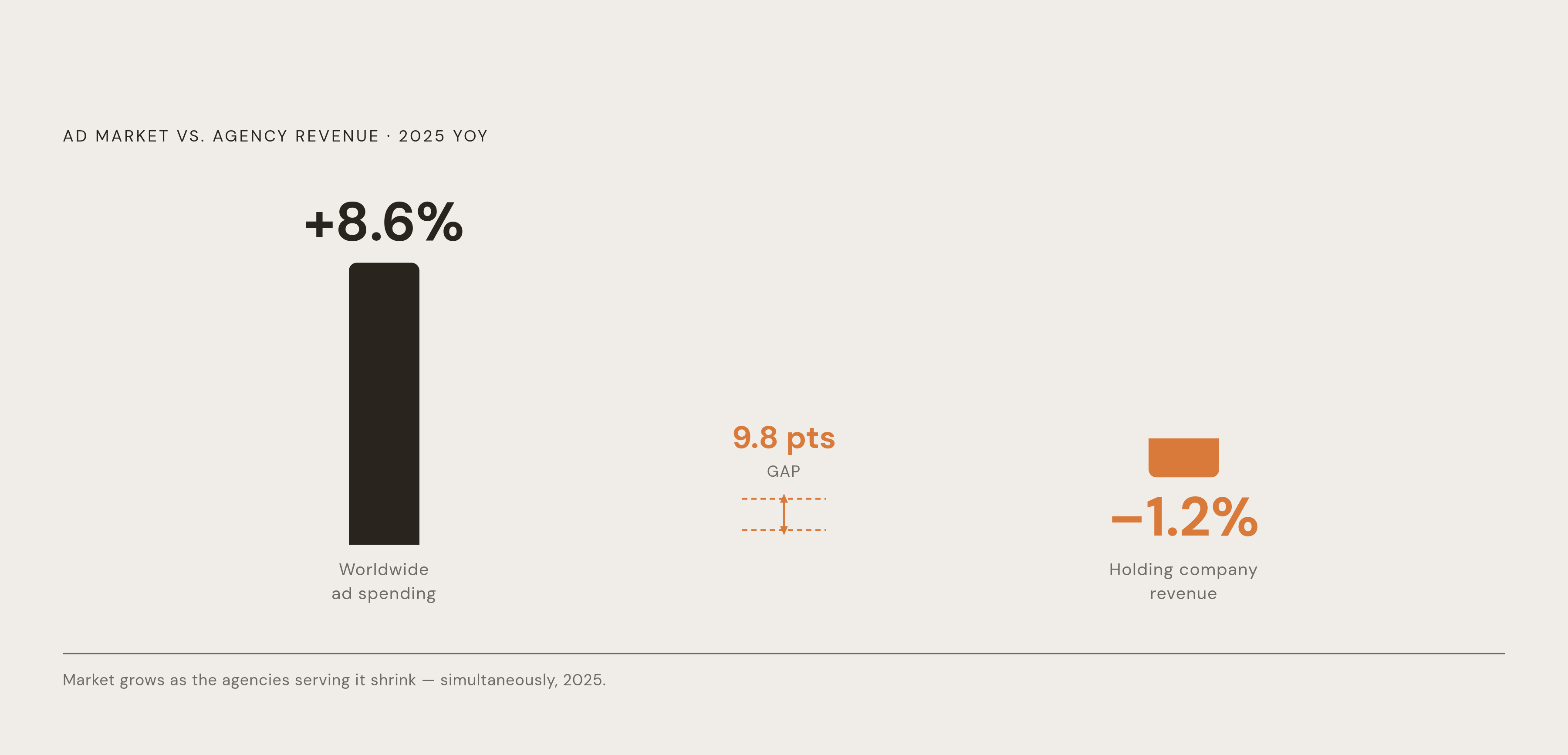
Ritner Digital found that ad spending worldwide grew 8.6% year over year in 2025, while holding company revenue fell 1.2% over the same stretch. The market for marketing got bigger, and the agencies serving it shrank anyway. That gap is the whole story.
Forrester's forecast expects 15% of agency jobs to disappear in 2026, stacked on an 8% cut across agencies in 2025, and that's not a slow bleed. Forrester's forecast expects 15% of agency jobs to disappear in 2026, stacked on an 8% cut across agencies in 2025, two years of layoffs back to back. That's two years of layoffs back to back.
Client intent backs it up. A Typeface survey of more than 200 senior marketing leaders found 60% planned to spend less on agencies in 2025 because of AI, and 83% said they'd cut most or all agency spend if content creation could be fully automated. Mavlers reports that among teams already running AI agents, 73% had already trimmed agency spending on content. Meanwhile, insourcing was already underway before generative AI showed up. AI just sharpened the edge on a trend that was already moving.
None of this means a new competitor is stealing agency clients. It means the founder's own team is unbundling the retainer, one task at a time, long before anyone picks up the phone to cancel it.
There's a real counterpoint, and it matters. Mavlers reports that roughly 36% of marketers still lean on agencies for content planning, and 62% still use agencies for AI-enabled paid media. Orchestration and accountability still command a fee. What's exposed is the execution layer: the routine production work AI now handles at a fraction of the cost.
The specific deliverables AI now handles (and the ones it still doesn't)
Ritner Digital identifies the tasks most exposed right now: content production, social posts, simple design work, reporting, routine research. Easy to describe in a sentence, easy to prompt for, easy to price against each other.
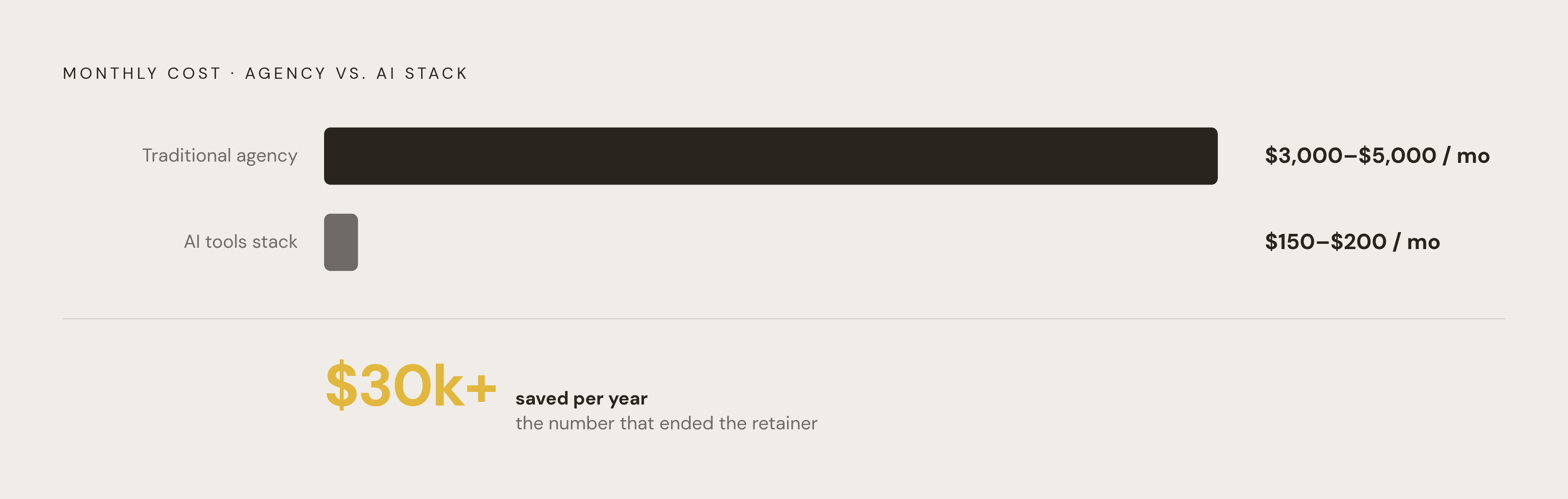
VectoSolve's 2026 cost breakdown puts numbers behind that comparison. Logo vectorization runs $75 to $200 through an agency, versus a small fraction of that through AI. Zoom out to the stack level: getprofitpulseai.com's 2026 figures put a traditional retainer at $3,000 to $5,000 a month, against roughly $150 to $200 a month for an AI tools stack covering the same ground, a gap that runs north of $30,000 a year. That gap runs north of $30,000 a year. That's the number driving the decision, not some vague sense that AI is cheaper.
None of that touches brand strategy. AI still can't do a convincing job on original concept development for complex visual systems, multi-page print-ready production files, or the cross-channel judgment that decides if a campaign actually holds together. Letting AI handle volume execution keeps human help around only for the work that needs judgment. That's a different relationship than paying a flat monthly fee for everything, including the parts a machine already does faster and cheaper.
Mavlers reports that AI-native micro-agencies run at 50% to 80% margins, against 15% to 20% for traditional agencies. They got there by cutting the junior execution layer AI now handles on its own. Startups don't need to hire a micro-agency to make that same cut. They can make it in-house, and most of them should.
Editability: The Feature That Separates Useful AI Design Tools From Expensive Dead Ends
Two different categories of AI design tool exist, and mixing them up wastes money. Pure generators create an asset from a prompt and hand it back finished, often locked down. AI-assisted tools embed those same generative features inside a broader, editable workspace instead. They solve different problems, and a startup that treats "AI design tools" as one bucket will pick the wrong one at least once.
A tool with no brand enforcement lets off-brand assets slip through the moment more than one person on the team starts using it. Nobody notices for a month. Then someone's cleaning up six different shades of the same blue across a pitch deck, and that cleanup quietly eats the savings that made the switch look good on paper.
The real tension sits between speed and control. Some tools generate an asset in seconds but lock the output down. Others let a user edit freely but never enforce brand rules to begin with. Either way, if a non-designer on the team can't actually modify what they get back, the retainer hasn't been replaced. The bottleneck just moved from an agency's queue to a support ticket, and that's not progress.
Full control, in practice, comes down to small things: changing a headline without regenerating the whole graphic, swapping a logo without the layout falling apart, resizing a social post for a pitch deck without rebuilding it from zero. Copyright matters too. Legal frameworks around AI-generated design are still settling in 2026, and Adobe's approach of training on licensed data is becoming a real differentiator for teams that care about commercial use rights on their marketing assets.
Judge any tool against three questions. Is it editable? Is it brand-aware? Does it come with commercial rights attached? Skip a tool that fails any one of the three, no matter how good the demo looks.
AI design tools that map to the retainer's core deliverables
The Business Research Company, via Medium, puts the AI-powered design tools market at $8.22 billion in 2026, up from $6.74 billion in 2025, on pace for $18.16 billion by 2030 at a 22% compound annual growth rate. The design tools that survive that competition are the ones worth using, not the ones with the loudest launch post.
No single tool covers a retainer's full scope. Chasing one platform that claims to do everything wastes time better spent connecting a handful of specialized tools to the workflow a team already runs.
Slides and pitch decks run well through Microsoft Designer, which uses DALL-E–based image generation and draws from user-defined brand style guidance to apply design rules automatically. For a founder or marketer with no formal design training, it's a solid fit where the bar is "on-brand and fast," not "art directed."
Social graphics and ad creatives split across two tools worth knowing well. Adobe Firefly generates images, video, audio, and vector art from prompts, and plugs directly into the rest of Adobe's ecosystem. Its real edge for a startup is brand safety and licensing, which matters for teams worried about IP risk down the line. Recraft builds a reusable custom style from a team's own reference images, no model training required, so generated assets match the brand instead of matching whatever house style the tool defaults to. Output stays consistent across social posts, icon sets, and product illustrations, and commercial rights are available on paid plans.
Brand asset generation and raw image quality still belong to one model at the top of the pack, so treat that model as an ideation and asset-sourcing layer feeding into an editable tool downstream. Recraft's custom style training is what separates it from generic template tools, which tend to generate in the tool's own visual style rather than the brand's.
Workflow and ideation run through Adobe Firefly Boards, a collaborative surface for generating a wide range of visual directions fast. The output there is thinking material. Useful for early campaign concepting before anything gets locked down, not for shipping.
On price, most of this stack runs from free tiers up to a modest monthly amount per seat. Research pegs a comparable AI tools stack at roughly $150 to $200 a month against a $3,000 to $5,000 retainer.
What to Look for When Evaluating a Tool Against a Retainer Deliverable
Run every candidate through the same core test: does it produce an editable output that a non-designer on the team can own, change, and reuse, without routing it back through a design handoff? If the answer is no, stop evaluating and move to the next tool.
Then check the specifics that make or break it in practice:
- Can the tool enforce logo placement, color palette, and font choices automatically, or does someone re-upload the brand kit by hand every single time?
- Can the team produce ten variants of a social graphic in less time than it takes to brief an agency on one? If not, the speed advantage that justified the switch has already disappeared.
- Does the output come with clear commercial rights, or is that locked behind a paid tier? Recraft's $10-a-month plan unlocking commercial rights is a useful benchmark for what "clear" looks like.
- Does the tool connect to how the team already works, Slack, Notion, whatever file formats get passed around, or does it demand a separate parallel process that quietly dies by the end of the first quarter?
Adoption is well past the early-adopter stage. The Designer Fund's AI in Design report found 91% of designers use AI for design tasks weekly, and Figma's State of the Designer report put generative AI use in workflows at 72%. A startup no longer needs to decide whether to make the switch; it needs to decide which tool fits which job on the list.
Build the stack around the retainer's actual line items, not around whichever tool has the loudest marketing. And settle early where human judgment still earns its price: brand strategy, campaign concepts, complex multi-page print production. That's what keeps the retainer conversation honest, so nobody keeps paying full price for execution work a machine already handles.
Making the Transition Without Losing Brand Consistency or Creative Control
Tools with no enforcement let off-brand work pile up the moment more than one person touches them. The fix is picking tools that build brand rules in from the start, rather than trusting every team member to apply them correctly from memory, every time, under deadline pressure.
Before switching anything, document the brand kit properly: logo files, exact hex codes, approved fonts, tone guidance. That single step turns a generic AI generator into something that behaves like a brand-aware collaborator instead of a slot machine for images.
Start the switch with the highest-volume, lowest-risk work first: social graphics, ad variants, the stuff where iteration is cheap and an off-brand miss doesn't cost much. Prove the workflow there before moving slides and one-pagers over.
The in-house designer's role changes shape here rather than disappearing. Instead of producing every asset by hand, the job becomes configuring templates, brand kits, and guardrails so non-designers can turn out on-brand work without needing sign-off on every single file. The Designer Fund's report found 65% of designers already taking on more product or engineering responsibility. Designer-as-production-line is giving way to designer-as-systems-architect, and that shift is further along than most founders realize.
The retainer conversation doesn't have to end in full cancellation. Mavlers found that 36% of marketers still lean on agencies for content planning and 62% for AI-enabled paid media, cutting the execution retainer while keeping strategic advisory work priced as its own separate contract. Those are two different jobs. Treating them as one line item was always the retainer model's real flaw, and untangling them is the actual work of this transition, not just swapping software.
Startups that make this switch early build an advantage that's hard to claw back later: brand consistency that holds at scale, content that moves at the speed of a Slack message instead of an agency queue, and a marketing engine that never stalls out waiting on a turnaround estimate. Competitors still paying the old briefing tax on every asset are working with a real handicap now, not a theoretical one.
Sources
- AI vs Agencies: Tools Over Retainers in 2026
- How Small Businesses Are Cutting Design Costs by 80% with AI Tools in 2026
- The Agency Model Is Breaking in 2026 — Here's What Comes Next — Ritner Digital | AI Search & SEO Agency
- The 5 AI Marketing Tools That Will Replace Your Agency (2026)
- AI in Design 2026: Best Tools, Real Workflows, What's Next | Devlin Peck