Approval Loop Bottlenecks in Marketing Creative Production
Approval delays cost marketing teams more missed launches than poor creative ever could.

Marketing teams keep missing launch dates, and the usual suspects, bad creative or bad strategy, aren't the reason. Knak's 2026 survey of over 300 enterprise marketing leaders found approvals cause more missed launches (47%) than creative production (38%). Eighty-five percent of teams missed at least one planned campaign launch in the past year over workflow problems, not talent problems. The gap sits in the handoff layer, the space between a finished idea and a live campaign, and fixing it means rethinking how assets get built and reviewed in the first place.
How much of the marketing workday approvals consume
Adobe's 2025 global marketing study puts a number on it: 58% of marketers name admin work, reviews, and approvals as their biggest time sink, and that overhead eats 41% of content-creation time. So roughly 25 minutes of every working hour goes to waiting on someone else's sign-off, not to making anything.
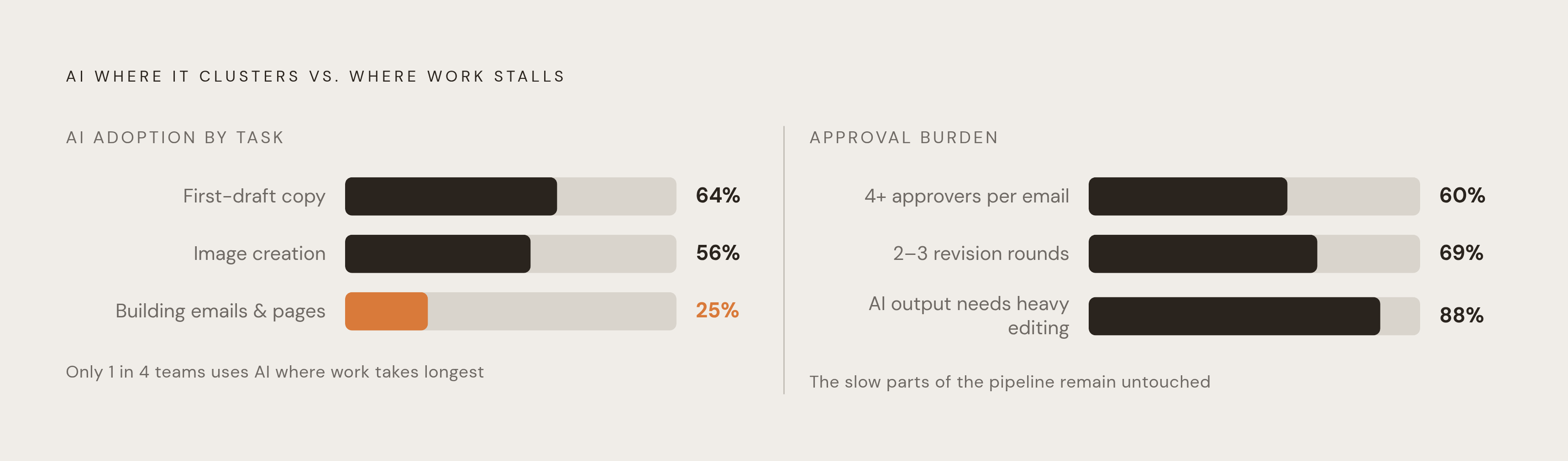
A single email shows the scale of it. Sixty percent of organizations pull in four or more people to approve one, 54% bounce it across three to five separate tools during production, and 69% need two to three rounds of revisions before it ships. Knak puts the internal labor cost at over $300 per email, once every person's time gets added up. Half of marketers still run this whole process through email, Slack, or Teams, and none of those tools were built to track version history or record who signed off on what.
The workload isn't holding steady, either. Sixty-two percent of marketers say content demand has jumped at least fivefold in two years. A process that already couldn't keep pace now has to carry a heavier load on the same broken rails. This isn't a small-team problem: Knak's respondents include teams running marketing for Google, Amazon, Uber, Meta, and OpenAI. Real budgets, real headcount, same loop.
The six specific points where approval workflows break down
Bottlenecks rarely appear as one big failure. They build in small, repeatable ways until the pipeline stalls out. Six patterns occur repeatedly.
A brief that skips a structured format invites open-ended back-and-forth before any creative work even starts. A media buyer sends a rough outline, the creative team comes back with questions, the marketing lead revises, and by the time everyone agrees on what's actually being made, the production slot is gone. The timeline has already slipped, and no asset exists yet.
Feedback without a shared standard turns reviews into arguments instead of sign-offs. A creative director checks visual quality, an account manager checks brand rules, a client checks message fit, and none of them work off the same criteria. The feedback contradicts itself, and untangling it burns days that shouldn't need to exist.
Legal and compliance often get looped in after creative decisions are already locked, which forces a partial or full restart. That's the predictable result of treating compliance as a final gate instead of building it into the brief from day one, and it's the single fix teams put off longest because it means changing the brief template rather than adding another reviewer.
In large organizations, brand managers, product teams, legal, media planners, and regional directors each add another sequential checkpoint. Nearly 90% of marketers already face three or more approval stages, and the problem doesn't scale evenly with company size. It scales faster than that.
Fifty-four percent of teams juggle three to five tools just to produce one email, so approvals end up scattered across email chains, offline edits, and spreadsheet trackers. Version control breaks down, feedback gets lost, and nobody's quite sure who's holding the current draft.
AI adds a sixth failure point, and it's the least obvious one. Most teams already use AI in production, yet 85% still missed a launch last year, because AI use clusters around the parts of the process that were already fast: 64% for first-draft copy, 56% for image creation. Eighty-eight percent of marketers say AI-generated content still needs moderate to heavy human editing before it can publish. AI hasn't shortened the review cycle. It's just changed who touches the draft first.
The structure of creative assets and its effect on approval times
Most approval friction gets baked in long before anyone opens a review tool. It comes down to how the asset got built in the first place, and this is where most teams look in the wrong place for the fix.
When every campaign is built from scratch, reviewers have no shared reference point. They end up re-litigating brand decisions, layout choices, and copy conventions on every single asset, as though the brand guidelines never existed. A workflow built on locked, brand-governed templates flips that: reviewers zero in on what actually changed, the message, the offer, the targeting, instead of re-checking things that got settled weeks ago.
Manual production multiplies the review load in a way that's easy to miss. A single Meta campaign launch can need twelve to twenty distinct asset combinations at minimum. Each one gets built by hand, so each one is a fresh opportunity for brand drift a reviewer has to catch. A master-template model generates every size and format from one source of truth, so brand decisions get made once instead of re-argued twenty times over.
Boozt makes the case better than any general argument could. The company produced 27,766 creatives in 2025, with roughly 90% of them handled by a single campaign designer. That number isn't just proof that template-based production runs faster. It shows manual methods hit a ceiling that template systems don't. Reviewing 27,766 assets built from one governed master is a fundamentally different job than reviewing 27,766 one-off files, even though the count is identical.
What a functional approval workflow looks like, stage by stage
None of this depends on buying a specific tool. It depends on sequence, on the order decisions get locked and who weighs in when.
The brief itself is the first approval gate, and most teams treat it as an afterthought, which is exactly backwards. A solid brief needs five things before it goes anywhere: the campaign objective (one metric, not five), the primary message ranked by priority, exact format requirements, reference creative showing what "good" looks like, and hard constraints on what can't appear. Reference creative is the field most teams skip, and it's the one that matters most: when a creative team has something visual to react to instead of a paragraph to interpret, revision cycles drop noticeably. Setting approval criteria this early, instead of discovering them mid-review, meaningfully shortens review cycle time.
Roles get mapped before anyone starts producing. Every person touching the project needs a defined lane: content creator, marketing manager for strategic fit, brand custodian for guidelines, legal reviewer for compliance, executive approver for the final call. Ambiguity over who actually gives the last sign-off is one of the most common reasons a review stalls out indefinitely.
Legal and compliance move upstream. Instead of reviewing a finished asset and sending it back, compliance builds pre-approved language, claim limits, and required disclaimers directly into the brief. That single change removes the most common reason approvals restart from zero.
Feedback lives in one place, in context. With half of teams still routing approvals through email or chat apps, version control failures and missed edits are close to guaranteed. A centralized review tool keeps comments attached to the actual asset, assigns someone to resolve each note, and leaves a clean audit trail. Routing creative tasks through a system like this can meaningfully cut cycle time.
Final sign-off is a yes-or-no question, not another round of notes. If the brief was clear and the middle-stage reviews were structured, the last gate asks one thing: does this meet what the brief asked for? Nothing more than that.
Template systems, design governance, and review surface area at scale
A design system works by taking certain decisions off the table entirely. Layout, color, typography: once those are locked at the template level, a reviewer can't reopen them on every single asset. That's the whole mechanism, and it's why governance beats good intentions every time.
The case isn't only about speed. Consistent brand presentation across channels is linked to revenue gains of up to 33% according to Lucidpress/Marq, which makes governance a commercial decision.
For teams without in-house designers, locked templates with editable fields, open for copy and imagery, closed for brand elements, let people self-serve without producing off-brand work that then has to be fixed. Some creative teams have rebuilt their template libraries around actual request patterns, letting non-designers produce on-brand materials on their own. That freed the creative team to focus on strategy instead of fielding one-off requests, and review cycles shrank as a result. Organizations that have adopted governed, self-serve templates report the same pattern: review cycles shrink even on teams with limited design resources.
Design systems fail plenty, roughly 60% of them do, and the failure often comes from within the organization rather than from the technology itself. The fix isn't complicated. Put one person in charge of reviewing new template requests, retiring stale ones, and updating guidelines as the brand evolves. Skipping that role causes the system to drift, quietly bringing back the exact review burden it was supposed to remove.
There's a related payoff for teams working with editable, structured files instead of flattened static images, since reviewers have more direct access to the elements they need to check.
Where AI genuinely helps in the approval process
Seventy percent of teams already use AI somewhere in production. Eighty-five percent still missed a launch this past year. Those two numbers sitting next to each other say something specific: AI adoption and approval bottlenecks are coexisting right now, not canceling each other out.
Part of the reason is where AI use is concentrated. Sixty-four percent of teams use it for first-draft copy and 56% for image generation, both early-stage tasks that were never the slow part of the process to begin with. Only 25% use AI to actually build or code emails and landing pages, which is the most time-consuming work in the whole chain. And since 88% of marketers say AI output still needs moderate to heavy editing before it's publish-ready, AI hasn't shortened the review loop. It's added a new editing step in front of it.
AI helps in two places that actually matter: generating on-brand variations from an already-approved master asset, then routing those derivatives for a lighter review instead of a full cycle, and catching off-brand elements before an asset ever reaches the review queue, so a human reviewer never has to flag the obvious stuff. Everywhere else, it's mostly adding drafts to a queue that was already backed up.
Agentic AI, systems that route assets to the right reviewer automatically, auto-fill brief fields, or generate localized versions of an approved master without a person doing it step by step, is the next real shift here. It's early-adoption territory, though, not something most teams have running today.
Teams that fix the process first get more out of every AI tool they add. Speed up a broken workflow with AI and it just speeds up the wrong things faster. Speed up a workflow that already has a structured brief and a clear approval sequence, and the gains actually compound.
What teams that consistently launch on schedule do differently
The patterns in Knak's research point to structure as what separates teams that launch consistently from those stuck in recurring delay, not headcount and not talent.
Teams that launch consistently define approval criteria at the brief stage, not somewhere in the middle of review. They build creative from governed templates that already encode the brand's rules, so reviewers check message accuracy instead of re-litigating a font choice. Compliance sits upstream as a constraint baked into the brief. There's a single system of record for approvals, no chains of email or Slack messages standing in for a real audit trail. AI gets pointed at derivative work, localization, format adaptation, copy variants, only after a core asset has cleared approval, instead of generating first drafts that need a full review cycle of their own.
A large share of marketing teams cite limited time, budget, or staff as a real barrier to creative output. But the teams that get past this bottleneck aren't necessarily better funded. They've cut the rework loops that were quietly eating the capacity they already had. When anyone on the team can produce a compliant asset without waiting on a designer, review cycles shrink because there's less off-spec work clogging the queue to begin with. The assets that land on an approver's desk are ready to sign off on, not broken from the start.