Speed to Launch as a Competitive Advantage in Campaign Execution
Fixing workflow architecture, not adding people, unlocks faster campaign launches.

Speed to launch depends on what the workflow was built to do, not on how hard a team works or how many people sit on it, and most marketing workflows were built for a world that no longer exists. Go-to-market teams are now asked to ship personalized assets across five or six channels at once, on a cadence that would have been unthinkable a few campaign cycles ago, while the underlying architecture, the sequence of strategy, brief, creation, review, and deployment, still runs the way it did when a campaign meant one hero image and a print ad. That mismatch between demand and architecture is the actual bottleneck. Hiring another designer doesn't fix a structural lag any more than adding a second toll booth fixes a bridge that's too narrow for the traffic crossing it.
Every handoff between stages loses something besides time. Each of those transitions forces someone to rebuild context from scratch: what was approved, what was rejected, why a particular direction got killed in round two. That reconstruction cost multiplies with every revision, so a "quick fix" to a headline can cost an afternoon once it travels back through four tools and two people who need to be reminded what the campaign is even for.
None of this is a people problem, and it cuts against the instinct to throw more hands at a slow quarter, but the drag is structural, built into the number of times work has to change hands, and no amount of individual hustle closes a gap created by architecture. Solving it requires looking at the pipeline itself, not the people running through it.
How disconnected toolchains turn small delays into campaign-killing lag
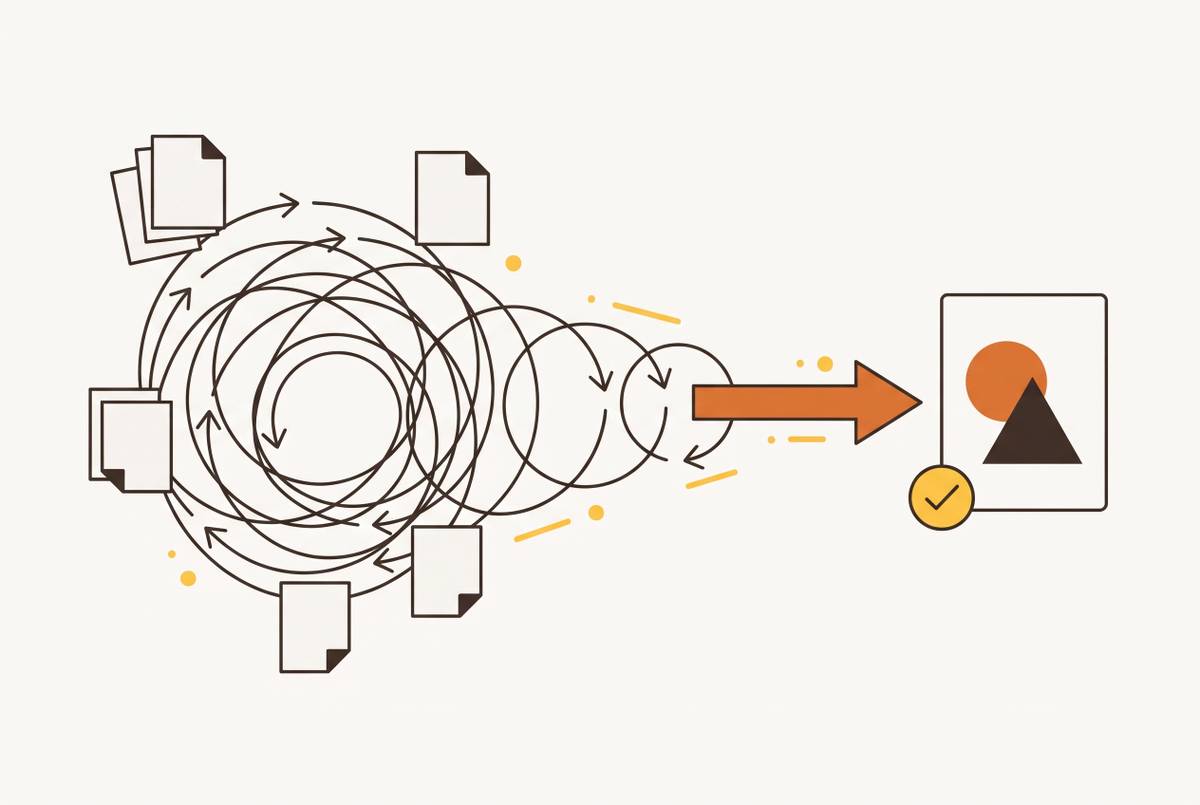
Time doesn't disappear during the work. It disappears between the work, in the gap where one stage ends and the next one has to reconstruct everything the last one knew.
Take a fairly ordinary six-stage campaign: brief, visual exploration, layout adaptation, mockups, review, and final channel delivery. Count the seams between those stages: there are at least five, each one a point where context, assets, and approvals have to be rebuilt by hand. None of this is anyone being slow. It's the absence of connective tissue between stages that were never designed to talk to each other.
AI can speed up the work inside any one of those stages. It can throw off a dozen headline variants or rough in a layout faster than a human could open the file. But generating faster inside a single stage doesn't touch the seams, and the seams are where the time actually goes. The biggest gains available to a go-to-market team come from collapsing those five transition points, not from making any individual stage faster. A campaign that generates visuals in ten minutes but still loses three days to handoffs between brief and layout and review hasn't gotten faster in any way that matters to a launch date.
Keep briefs, references, approved assets, and review criteria visible across the whole workflow rather than scattered across five tools, and something changes in how revisions behave. A change to an approved headline no longer means re-explaining the campaign to the next person in line. It means a change, propagated, reviewed against standing criteria, and shipped. That continuity, not raw generation speed, is what actually collapses calendar time.
What agentic AI changes about the execution loop
Agentic AI's real contribution isn't velocity inside the existing sequence of handoffs. It replaces that sequence with a continuous loop that a single person can oversee from brief to delivery, which is a structurally different thing than a faster version of the old process.
McKinsey's analysis frames the shift as a move away from practitioners operating isolated tools, toward hybrid human-agentic workforces where one marketer supervises a network of agents handling most of the execution. That's a different org chart, not just a faster version of the old one. Two-thirds of execution shifting to agents means the role changes from doing the work to supervising a network that does it.
None of that works without a technology foundation built for it. Bolt an agent onto a stack that wasn't built for it and the agent spends most of its time guessing, which tends to go about as well as it sounds.
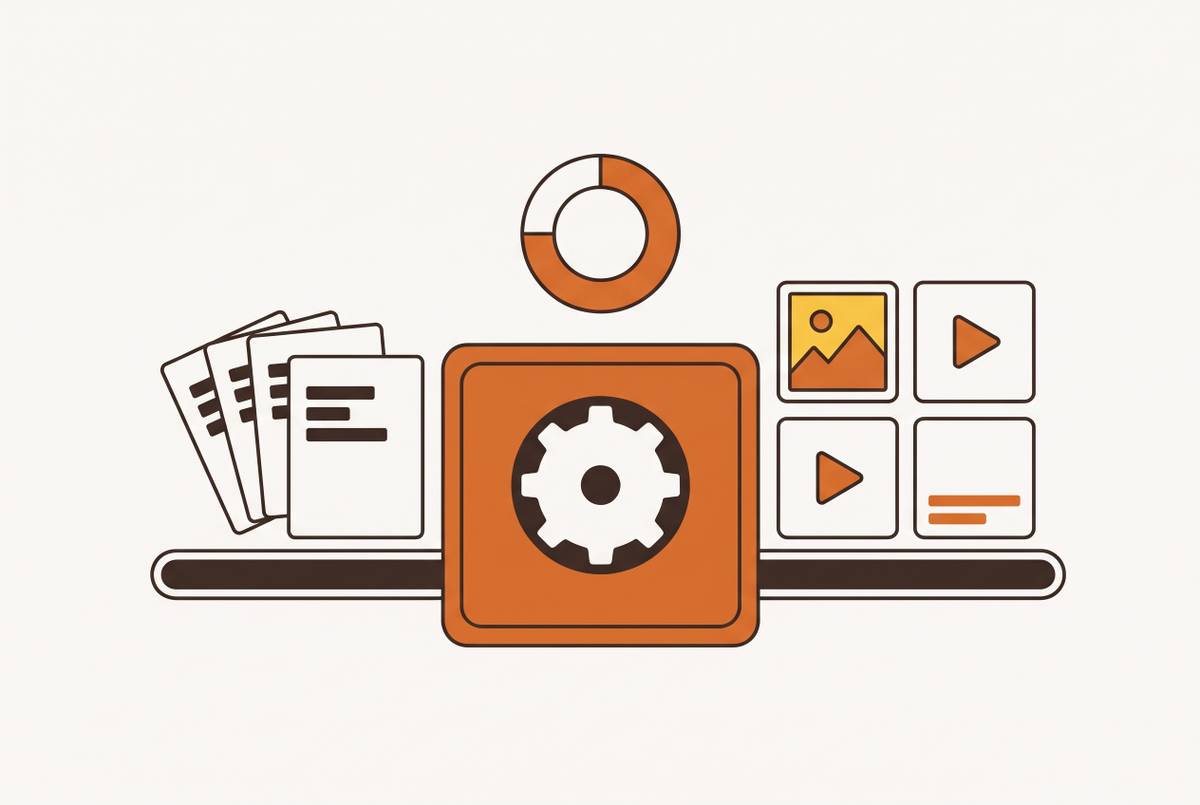
The actual value isn't speed within a task but the removal of the reset between tasks, so the brief, the visual direction, the layout system, the review, and the channel-specific versions move through one connected workspace instead of migrating across five disconnected ones. A chatbot that drafts social copy faster is a horizontal tool. A system that runs brief-to-delivery as one loop is vertical, and it's the one that actually changes the campaign's clock speed.
Teams seeing real gains keep a specific order intact: human strategy at the front, AI execution in the middle, human judgment at the back. AI doesn't own brand decisions. It doesn't own product truth. It doesn't own final approval at any point in the loop, and that division of labor is what keeps the loop fast without becoming reckless.
Brand consistency as the hidden tax on campaign speed
What happens when a team gets very good at producing a large volume of assets that can't actually be published?
High-volume AI execution risks producing unpublishable assets when brand consistency isn't built into the system from the start. Assets built outside a brand-trained system often need manual correction before anyone will sign off on them, and that correction pass is exactly the review time the whole redesign was supposed to eliminate. A team can generate a hundred versions of an ad by lunch and still ship zero of them if every one needs a designer to fix the logo placement and swap out an off-palette blue.
The fix is training the system on approved brand assets, guidelines, and prior reference work so on-brand output is the default the system produces, not a happy accident that occasionally survives review, rather than slowing generation down to catch errors later. Building that constraint into the generation stage shrinks the review stage almost automatically, because there's less to catch. This is the real difference between a brand kit sitting in a shared drive and a brand system operating as a constraint on every asset the team generates: one is a document nobody opens, the other is a rule the system can't violate.
Solve it at the point assets get created and it stops being a bottleneck at the point they get approved.
How go-to-market teams can rebuild the brief-to-asset pipeline around AI execution
A six-stage pipeline can move from brief to channel-ready assets without the context loss baked into the conventional handoff model, provided each stage is rebuilt with that goal in mind rather than just handed a faster tool.
Stage one normalizes the brief before anything gets generated. Turn it into an actual production checklist: audience, objective, offer, required formats, brand references, directions that are explicitly off-limits, and the criteria that will determine approval. An ambiguous brief produces ambiguous output at every stage downstream of it, so specificity here pays back more than specificity added at any later point in the chain.
Stage two generates a small number of genuine visual directions rather than forty near-identical variants that all say the same thing in slightly different fonts. Each direction should represent an actual creative hypothesis that can be tested against the brief, not a cosmetic variation on the first idea that came out. AI handles the exploration. A person decides which direction is worth advancing.
Stage three turns the approved direction into a layout system that can repeat itself. A connected workspace holding the generated assets, approved imagery, templates, copy, and every campaign size needed means the design doesn't get rebuilt by hand for each new channel. This is where the pipeline starts paying compounding returns: change the approved direction once, and that change propagates across every format instead of requiring someone to redo the work six separate times.
Stage six builds the channel-specific versions from the approved base, using AI for format adaptation rather than reinventing the concept per channel. The message, the image treatment, and the product angle hold steady. The dimensions and layout details are what flex.
What in-house AI execution displaces
The strongest objection to all of this is fair: can in-house AI execution actually match what an agency produces? The honest answer is yes, for a specific and fairly large category of work, and no for another category that isn't shrinking nearly as fast.
AI-assisted in-house execution now handles, at parity with agency output, social copy variations, ad format adaptations, monthly report templates, standard landing pages, and deck versions built for different audiences. A moderately capable in-house marketer with the right tooling can now reproduce that output without the retainer attached to it.
What doesn't get displaced is harder to name cleanly: call it the taste ceiling. AI narrows the gap. It narrows the gap between competent and exceptional without closing it, and pretending otherwise just sets a team up to ship something mediocre with great confidence.
The honest framing most teams eventually land on is a hybrid one: AI-assisted in-house execution absorbs the high-volume, repeatable formats, while agency or specialist work gets reserved for campaigns that need exceptional creative direction nobody on staff happens to have. That's a narrower role for outside agencies than they used to occupy, not a disappearing one.
The structural benefit of in-house execution is the speed of iteration, though the cost saved matters too. A team that can test, revise, and relaunch an asset in hours instead of days can run more experiments in a quarter, and running more experiments is how a team compounds what it learns faster than a competitor still waiting on an external production cycle to turn around a single round of revisions.
Why speed to launch compounds into a structural moat over time
Teams that rebuild their workflow around AI-assisted execution accumulate a learning advantage that gets wider with every cycle they run, a different kind of win than a one-time efficiency bump.
McKinsey's analysis frames this as a growth engine, one that threads insights, content, commerce, and performance into a continuous loop rather than treating each campaign as its own isolated project. That loop produces a faster campaign cycle, which generates performance data sooner. That data shapes the next brief. The sharper brief produces better-targeted assets, and those assets generate cleaner signal for the cycle after that. Speed to launch, looked at this way, is a rate of learning, and learning compounds the same way interest does: slowly at first, then suddenly.
The teams that will struggle to close this gap are not the ones without access to the tools, since the tools themselves are now widely available to nearly anyone willing to pay for them. The teams that will struggle are the ones who adopted AI without redesigning anything around it, bolting new generation speed onto the same sequential handoff architecture that was the actual bottleneck all along. They'll see a real improvement. It just won't compound, because the seams between stages are still there, quietly eating the gains one revision at a time.
The practical question for a go-to-market leader isn't whether to adopt AI-assisted design. That decision has effectively already been made by the market. The real question is whether the workflow surrounding it is built to let learning accumulate cycle over cycle, and that takes an editable, connected, on-brand asset system rather than a black box that spits out outputs nobody downstream can build on. Workflow architecture, not the speed of any one task inside it, is the variable actually worth competing on.