Template Governance Preventing Brand Drift at Scale
Systems, not PDFs, stop brands from drifting at scale.

Brand drift is a systems problem: a structural gap between what a brand guideline says and what a distributed team actually ships.
Why brand guidelines fail as an enforcement mechanism
Picture a sales rep three time zones from headquarters, racing a deadline, who opens last quarter's one-pager, swaps in new numbers, and sends it out with a logo that got retired two brand refreshes ago. Nobody told her not to. Nobody checked. The guideline existed somewhere, probably as a PDF, probably unopened in months, and it had no say in what actually left her laptop.
The pattern repeats at every scale and in every department. The words are the same. The interpretation isn't, and nothing in a PDF forces convergence.
Three separate failures stack on top of each other here, each requiring a different fix. And learning fails because standards don't update themselves: campaigns shift, customer expectations shift, competitors launch something that changes what "on brand" even looks like, and the guideline sits there printed in whatever year it was last approved.
Marq's brand governance framework makes an observation that cuts to the center of this: the tools most teams already have, a PDF guidelines document, a shared folder of approved logos, a review process that lives in email threads or Slack messages, are static formats paired with manual enforcement. The rules exist. They just aren't built into how the work gets done, so following them depends entirely on someone remembering to check, every single time, forever.
None of this means the guidelines themselves are badly written. The issue is categorical: a guideline documents intent, and documentation has no mechanism to enforce itself at the point where content actually gets made. Enforcement is a different layer entirely, and conflating the two is where most brand programs start to come apart.
How scale turns interpretation gaps into systematic drift
Adding one more content creator to an organization grows the interpretation gap by more than one. It compounds, because every new person, region, or channel introduces another point where brand intent has to survive translation, and the distance between intent and output widens with each handoff.
Design departments usually aren't where most branded content comes from, which surprises people outside brand and creative teams. Marq's digital brand governance guide documents this directly. These are the people closest to the customer and furthest from the brand toolkit, and they're the ones generating volume.
So what happens when all of that content has to route through one designer or a small central creative team? It just moved outside brand control entirely, which is arguably worse than slow output, since at least slow output is still visible.
Zoom out to a global organization, where the weak point sits in the middle, between headquarters and local teams. That's where standards get lost most reliably, bent to meet a deadline, or quietly ignored because nobody's checking. Marq's global brand management framework identifies the mechanics: more locations mean more content demand, more languages mean more translation cycles, and more organizational distance means the guideline decays faster the further it travels from whoever wrote it.
The tool stack doesn't help. Per Adobe's analysis, no single layer connects interpretation, enforcement, and learning into one closed loop. Each piece does its job in isolation, and the gaps between them are exactly where drift lives.
The clearest symptom of all this in sales and presentation content has a name, and it's an accurate one: the Frankendeck. It's the sales deck stitched together from three different template eras, two different color treatments, and a logo that's been resized so many times it's gone slightly blurry. It's what happens when five people inherit five different versions of "the template" and nobody owns the one source of truth.
What template governance is, and what it is not
Three capabilities get lumped together constantly, and separating them is the whole trick. Making a template available to a team is one thing. Checking whether finished output matches that template is another. Locking a template so a user physically cannot deviate from its protected elements is a third, and it's the only one of the three that actually prevents drift rather than just measuring it after the fact. Most marketing tools stop at the first two.
Template governance is the third one. It means specific elements, logos, fonts, brand colors, required compliance language, get locked at the object level so they cannot be altered, while other zones stay open by design: contact details, regional photography, localized copy, pricing specific to a market. The boundary between locked and editable is drawn on purpose, element by element, because the two decisions (what must never move, what has to adapt) carry very different consequences if gotten wrong.
Who gets to touch what matters just as much. Brand owners create and approve the master templates. Content creators, regional leads, marketing managers, partner teams, customize within the guardrails those templates set. Neither group can accidentally do the other's job, because the system doesn't let them, not because they've been trained not to. A rule stops people; a rail guides them without letting them stray.
Most governance programs either overcorrect or undercorrect at this point. There's no universal setting that gets this right across every brand element and every market simultaneously. Should imagery default to one template or five? Those are judgment calls, and they require someone to actually sit down and decide, deliberately, rather than letting a tool's defaults decide for them.
Brand compliance software like Templafy shows one way this gets built in practice: enforcement embedded directly inside the tools employees already open every day, Microsoft 365, Google Workspace, so the governance layer exists at the moment of creation instead of arriving later as a correction.
Why financial and legal exposure makes governance non-negotiable in regulated industries
An unlocked template is an annoyance in most industries. In financial services, healthcare, or legal, it's exposure, and the math on fixing it is not subtle.
A single non-compliant rate disclosure appearing in one regional market can trigger a regulatory review, halting the marketing calendar while compliance and legal sort out what happened and how far it spread. Compliance language has to be identical across every client-facing document, regardless of who built it or which office it came from, because regulators don't grade on intent. Marq's platform overview names this use case specifically: a regional financial advisor should be free to update a contact number or swap in a new headshot, but should never be able to touch the compliance language, the brand colors, or the approved imagery. Governance built by design removes the need to trust that every advisor remembers every rule on every document.
Marq's governance framework points to this gap directly: without structural guardrails baked into the templates themselves, oversight depends on hoping someone flags a problem before a customer, or a regulator, does.
Yext offers a working example of the alternative. The autonomy is the point, and the governance layer is what makes that autonomy safe rather than reckless, because the same mechanical question applies whether an organization answers to a regulator or to nobody in particular: what gets locked, what stays open, and who decides.
Building the governance layer in practice: what needs to be locked, what needs to stay flexible
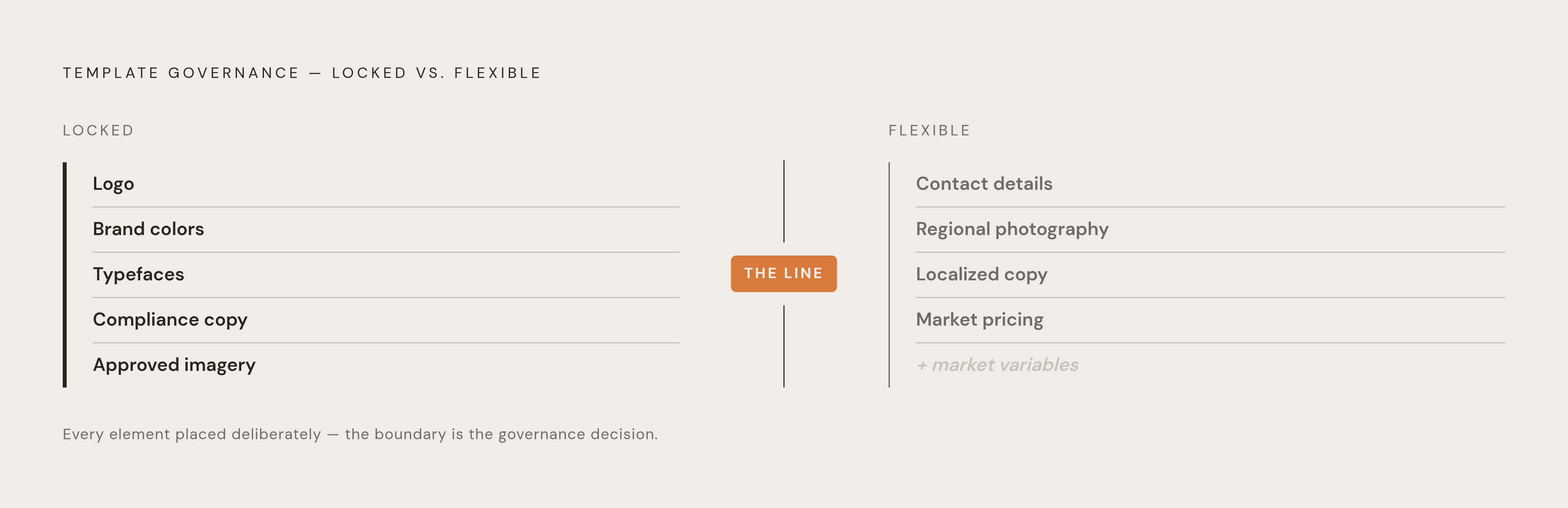
Every brand element deserves an honest answer to one question: how much latitude can a local team have here before the brand itself becomes unrecognizable? That answer should be documented, deliberate, and built directly into the template rather than left to judgment calls made under deadline pressure.
Marq's global brand management framework offers a useful starting map for where different elements tend to land. A logo is almost always non-negotiable everywhere, full stop on debate. Promotional pricing is almost always a local decision, tied to a specific market's currency and competitive conditions.
That spectrum belongs in a single governance map, distributed to every regional team, but a map in a shared drive is still just documentation unless it's wired into the templates themselves. If a logo is non-negotiable, the template should make editing it physically impossible rather than politely discouraged.
None of this works if people can't find the approved assets fast enough to use them. If a regional marketer can't locate the current logo file in under a minute, she'll reach for whatever's sitting on her desktop, three versions out of date. Governance infrastructure has to make the right asset the easiest one to grab, which in practice means connecting to the digital asset management systems a company already runs so approved logos, images, and legal disclaimers surface inside the creation workflow itself, not in a separate folder search that nobody has time for at 4:45 on a Friday.
For presentation and sales content, the fix is almost embarrassingly simple to state and surprisingly rare in practice: one master template per asset type. One source file for sales one-pagers, one for QBR decks, one for LinkedIn carousels. That alone eliminates the Frankendeck at its source, since there's no longer a universe of competing template versions for five different people to pull from.
Social content calls for a different split. Lock the core identity, logo, color, type, the general imagery treatment, and let the frame flex. Layout can and should adapt to whichever platform the post is headed for, since a square image behaves differently than a vertical one, but the visual identity underneath stays constant no matter where it's published.
AI-generated content slots into this same architecture rather than requiring a separate one. It's filling in a field that's already fenced.
Where template governance reaches its limit: the agentic brand drift problem
So does locking templates solve brand drift, fully, for good? No, and pretending otherwise would be the weak spot in this entire argument. A 2026 paper in Business Horizons, by van Esch and Cui, available online May 28, 2026, identifies a failure mode that locked templates were never built to catch.
The paper's argument: as autonomous AI systems take over more of pricing, content generation, personalization, and supply chain decisions, the human judgment calls that historically shaped a brand's identity get displaced, one small decision at a time. The paper calls this agentic brand drift, and it names three mechanisms behind it: Decision Diffusion, where responsibility for brand-bearing choices spreads across so many systems that no single person owns the outcome; Temporal Collapse, where AI systems optimized for short-cycle performance gradually erase the long-term consistency a brand identity depends on; and Accountability Dissolution, where no human is left holding responsibility for what the aggregate output has become.
What makes this genuinely unsettling, rather than just another governance buzzword, is that it's invisible to the tools built to catch problems. And it falls outside the frameworks organizations already lean on for AI oversight: the paper points out that a company running NIST AI RMF or ISO/IEC 42001 without a single misstep will still experience agentic brand drift, because those frameworks govern how systems behave, not whether the meaning behind a brand stays coherent over time.
So where does that leave template governance? Not obsolete, and not undermined. It solves a different, narrower, far more immediate problem: the human-created drift that happens when a sales rep, a regional office, or a partner network makes a judgment call without the guardrails to catch it. That problem is live right now, in every distributed organization running content through more than one office. For GTM and operations teams reading this now, close the human drift gap first, because that's where governed templates deliver value today, measurably, and address autonomous systems once the AI stack is doing enough independent decision-making for it to matter.
What strong governance looks like as a measurable outcome
Good governance is measured in numbers, not in how polished the brand book looks on a shelf. The Yext example shows one small central design team supporting thousands of employees, producing over 100 localized sell sheets from a single governed template, with zero need to route each one back through a creative queue. That's throughput a traditional request-and-wait model could never sustain, and it comes from the system doing the enforcement work a human reviewer used to do by hand.
The @properties case points at the inverse metric to track: how long content sits waiting for approval, and whether that wait time is actively pushing people outside the system. Four to six weeks for a template request isn't just slow. A governance system that brings that number down to something closer to real time removes the incentive to defect in the first place.
The Frankendeck gives a qualitative check that's just as real as any dashboard metric: open ten decks built by ten different reps and see whether they look like they came from the same company. If they do, the master-template approach is holding. If they don't, it's an early warning sign, well before any customer complaint or compliance flag makes the problem official.
None of these numbers measure creativity or brand voice directly, and that's fine, because that was never the job. They measure whether the gap between what the guideline says and what the team actually ships is closing or widening. Brand drift was always a systems failure, and a system is the only kind of thing that can fix it: not a better PDF, not a more inspiring guideline, but a structure that makes following the brand the path of least resistance instead of one more thing busy people are counting on themselves to remember.