Why Sales Teams Get Stuck Waiting on Design and How AI Platforms Break the Bottleneck
AI platforms let sales teams bypass design queues by building on-brand assets themselves.
Picture the setup: the rep wrote the follow-up copy an hour after the call, the meeting is locked for Thursday, and the only thing standing between "ready to send" and "sent" is one slide that needs a logo swap. The design queue a sales team hits is working exactly as it was built, for a different job.
Most design queues form the way sediment forms: approval chains pile on top of unclear ownership, which piles on top of tool sprawl, which piles on top of an intake process nobody designed on purpose. Adding a second designer to that system doesn't fix it. Telling the existing designer to move faster doesn't fix it either, because the problem was never how fast any one person works.
Low-value tasks are what really clog the pipe: resizing an asset for a new platform, swapping a date on a deck, reformatting twelve slides because the font changed. None of that is strategic work, and none of it is why the design team was hired, yet it makes up the bulk of what lands in the queue. Meanwhile, approval theater adds its own tax on top. The production time and the waiting time have almost nothing to do with each other, and that gap is the whole story of why sales keeps waiting.
Where the bottleneck hits sales hardest
This isn't a creative ops inconvenience; it's a sales productivity problem wearing a different badge. The design queue doesn't cause that drag. It adds another line item to a budget that was already overspent.
Run the calendar forward on a realistic case. A rep submits a deck request Monday morning for a Thursday meeting. The designer, buried under six other requests of equal or higher priority, gets to it Wednesday afternoon. The deal was lost gradually, not in a single moment. A proposal that lands a day after a competitor's proposal rarely gets reopened for a fair comparison.
Pressure cuts the other way too. That's how a logo in the wrong shade, a font that doesn't match the deck template, or a color palette lifted from last year's campaign ends up in front of a buyer. It looks like a small thing until it happens three times in one quarter and the brand team starts asking why sales materials look like they came from four different companies.
The bottleneck also has a habit of relocating rather than disappearing, a pattern worth understanding before any fix gets proposed. Limestone Digital ran a pilot where an AI-accelerated engineering team started shipping code faster than the business could decide what it actually wanted built next. So Limestone moved the AI agents earlier in the process instead, giving the business something concrete to react to sooner. The lesson travels well outside engineering: speeding up one team without touching the handoff just moves the traffic jam to whoever's next in line, and for sales, whoever's next in line is usually design.
Why AI accelerates the problem before it solves it
AI writing tools solved a real problem and created a quieter one. A rep can now produce campaign copy, outreach sequences, and follow-up drafts in minutes instead of hours, which sounds like exactly the fix this piece has been building toward. But that copy still needs a home: a slide, a one-pager, a carousel, a PDF that looks like it came from the company rather than from whoever had the fastest laptop that afternoon. Every one of those formats still has to pass through the same design queue that was already backed up before AI showed up.
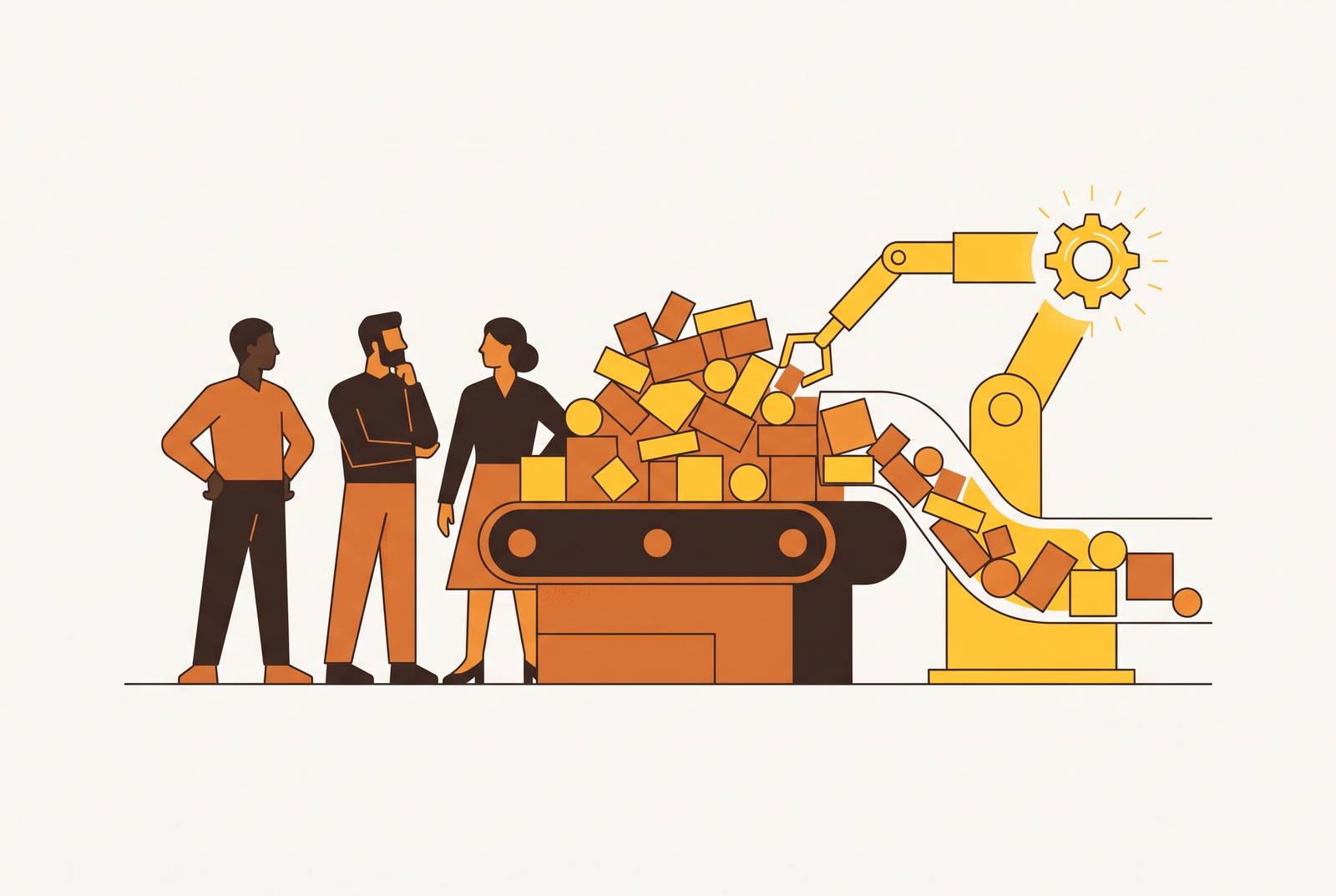
This is the theory of constraints in its plainest form. Speeding up a step that isn't the actual bottleneck doesn't speed up the process; it just lengthens the line in front of the step that is the bottleneck. Marketing writing five times more copy per week doesn't help if design can only turn three pieces into finished assets in that same window. The queue doesn't shrink. It grows, now full of urgent, AI-generated, time-sensitive material.
A newer complication follows right behind it. When sales and marketing start generating content faster than design can process it, some of that content inevitably gets built outside the design system entirely, in whatever tool was closest at hand. It doesn't carry the right fonts, the right colors, or the right logo treatment, so it needs a pass through brand review before it can go out under the company's name. Brand review becomes the new bottleneck, even on days when the underlying content was ready to send an hour after it was written. AI made the writing faster and left the packaging exactly as slow as it always was.
AI that works at the generation layer
So where does the queue actually break? Not by making the review step faster. It breaks when the rep doesn't need a design handoff at all, because the brand rules are built into the tool doing the generating rather than applied afterward by a human checking the output. That's a structural shift, not a speed upgrade, and it's the distinction that separates a tool that fixes the bottleneck from one that just moves it.
The structural fix looks like a shared library: brand tokens (colors, fonts, logo rules, spacing) and reusable components stored centrally, so that go-to-market teams can build what they need without routing every request through a designer's queue. AI is what makes this workable for people who've never opened a professional design tool in their life. The rep describes what they need in plain language, and the system handles the layout and formatting decisions that used to require actual design training, producing something that's already on-brand by construction.
That last part is the whole test: a tool that generates a rough draft and then routes it to a designer for a brand-compliance check hasn't removed the queue. It's just added a new step in front of the same queue, dressed up as automation. A tool that actually solves the problem can't produce an off-brand asset in the first place, the same way a vending machine can't accidentally sell you a sandwich when you pressed the button for chips. Brand tokens enforced at the point of generation mean a sales hire two weeks into the job can't stumble into an off-brand deck even by accident, because the system was never going to offer that option. Consistency stops depending on anyone's discipline or a reviewer's attention span. The decision about what ships still belongs to a person. AI just shortens the distance between asking and having something to react to.
What sales teams can produce with the right tool
Case studies are a good test of whether any of this actually works in practice. With a self-serve system in place, a sales manager can assemble a case study the week a deal closes, while the details are fresh.
Social content for outbound tells a similar story. Produced directly by the rep, on-brand from the first draft, that same post goes out in minutes instead of sitting in someone else's queue behind four other requests.
None of this works, though, if the output is a flattened image file. A static graphic that can't be touched after it's generated just recreates the design queue one layer down, because the moment pricing changes or a testimonial needs swapping, the rep is back to filing a request. Every asset needs to stay a living, editable document, the kind a rep can open, adjust, and reuse without starting over or waiting on anyone else to make the change for them.
How brand consistency survives without designers in every loop
The objection that deserves a real answer, not a dismissal: if reps are building their own assets, won't the brand turn into a mess of mismatched fonts and off-brand colors within a quarter? The pressure-driven workarounds described earlier (reps skipping review, logos slipping through in the wrong shade) show that this concern is grounded in what's already happening.
The fix is not restoring the review queue that was never designed to keep up with sales cycles. The fix is moving brand governance upstream, into the generation step itself, so that a compliant asset is the only kind the tool is capable of producing. That's a different claim than "trust the reps to follow the brand guide." It doesn't rely on anyone's discipline. It relies on the system simply not offering an off-brand option to choose from.
This changes what a designer actually does day to day, and arguably for the better. Instead of reviewing the fourth resize request of the afternoon, the designer configures the brand rules once: the exact colors, the approved fonts, the logo clearances, the spacing grid. That's a materially higher use of design expertise than refereeing font choices, and volume alone isn't the enemy here. When the brand tokens are applied automatically at the point of generation, the review cycle shrinks, because there's simply less to catch.
The productivity case for in-house AI design over agency dependency
Agencies run on business days. Sales cycles run on hours, sometimes less, and that mismatch is structural, built into how agency production is staffed and billed in the first place, the same way the internal design queue was built structurally rather than through anyone's individual failure.
In-house AI design capability changes the unit of time entirely, bringing turnaround from days down to minutes for the asset types that come up constantly in a sales cycle: decks, one-pagers, social posts, follow-up materials.
Nobody needs to replace an entire design operation on day one to see the benefit. The practical path starts with whichever asset types most frequently miss their sales window, the ones costing deals right now, gets the brand system built around those, and expands into more complex formats once that foundation holds. A rep who can produce a leave-behind before they've left the parking lot is operating on a different clock than a rep who emails a request and waits to hear back on the drive home.
What to look for in an AI design platform
The tools that fail tend to fail the same way: they generate something, but that something still needs a designer's attention before anyone can use it, which just makes the queue wear a different interface.
A few criteria separate the tools that work from the ones that just relocate the problem.
Brand enforcement belongs at the generation step, not the review step. Colors, fonts, logo rules, and spacing should be locked to the brand system from the start, so every output is compliant by default.
Output formats need to match what sales actually uses: slides, one-pagers, PDFs, social assets ready to post, not static images that still require a separate design pass before they're deliverable.
Speed needs to match the moment a sales rep is actually in. A platform that turns a request into a finished, editable asset in minutes is solving the problem this piece is about. A platform that still takes hours, or that still routes through anything resembling a queue measured in days, is a faster version of the old system, not a different one.
Last, it has to work for someone who's never opened a professional design tool in their life. A rep on their first session should be able to produce something polished without a training session first, because the entire argument for this category of tool collapses the moment it requires the very design skill it was supposed to replace.
Start by auditing which asset types are currently stuck in that old queue and which ones actually cost deals when they're late. That list is usually shorter than it feels from inside the backlog, and it's the right place to begin.