Organizational Resistance to AI Design Tools Among Creative Teams
Buying AI tools for designers is easy; changing how teams work is the real bottleneck.
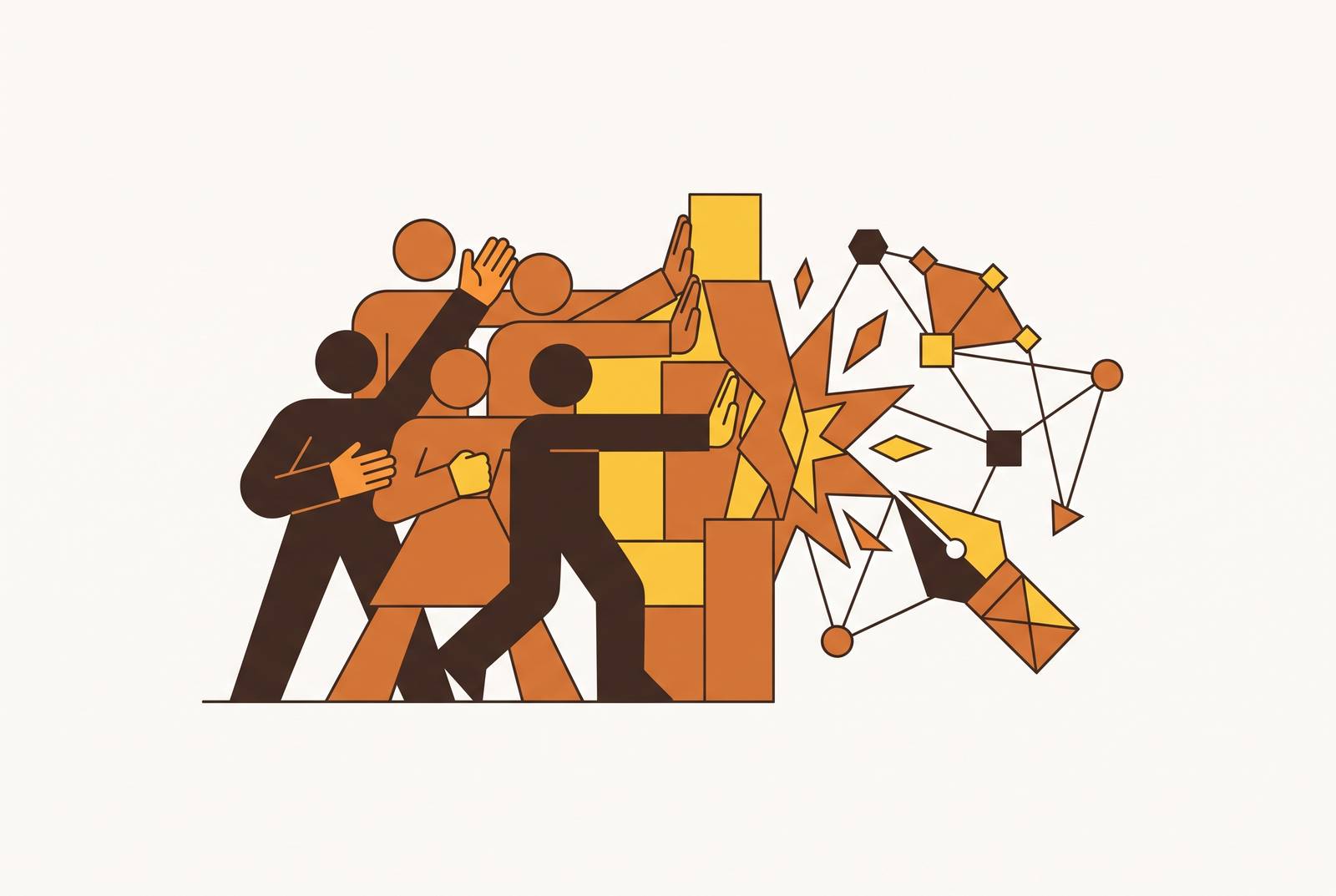
"We've bought the tools. What's the holdup?" That's the question a design leader asks after approving budget, rolling out licenses, and watching adoption crawl anyway. The AI in Design Report 2026 found that most designers report at least moderate organizational support for AI adoption, and more than half call that support strong: dedicated budget, active encouragement, formal programs. Yet nearly half of designers say they're still searching for a go-to toolset, and far fewer have settled on tools they use for most of their work. The gap is most visible at consultancies and design agencies, where formal support exists on paper but adoption still trails smaller, earlier-stage firms where people tinker because tinkering is just how work gets done there. Money bought the tools. It didn't buy the habit of using them.
Formal support and adoption
Organizations tend to treat AI adoption like a procurement decision: pick the vendor, sign the contract, announce it in a town hall, done. But adoption is an organizational change problem wearing a procurement costume, and that mismatch explains most of the lag described above. The AI in Design Report 2026 shows that few leaders have updated the formal processes that actually govern how design work gets done: performance reviews, team structures, hiring criteria. The tools arrived. The scaffolding around them didn't move.
Why does that scaffolding matter so much? Because tinkering, not training, is the real mechanism by which organizational investment reaches an individual designer's desk. Tinkering here means something specific: a culture where experimentation is expected and rewarded, not just tolerated as a side project squeezed between deadlines. Budget and encouragement without that culture produce a fraction of the result. The spend lands on individuals. The system around them stays exactly as it was.
None of this makes designers reluctant or leaders negligent. Both groups are working from incomplete maps. Leaders assume that funding a tool is equivalent to funding its adoption. Designers assume that if the organization wanted them to change how they work, someone would have said so by now, in writing, with a process to match.
The specific frictions that compound when structure is absent
Picture a mid-level product designer handed a new AI tool on a Monday with no update to how her work gets reviewed, no change to how credit gets assigned on a shared project, and no one above her who has used the thing long enough to answer a basic question about it. What does she do? Most people in that position use the tool quietly, for low-stakes work, and keep their real process intact as a hedge. That's a reasonable response to an unreasonable amount of ambiguity.
Several frictions stack on top of each other here, and no single one explains the slowdown by itself. Identity threat is one of them. Research into team dynamics in design contexts, including the ICED25 study on AI and creative fixation in design teams, found that AI changes who contributes what inside a team, and concerns about shifting hierarchy, skill devaluation, and the isolation of working beside a model instead of a colleague are measurable forces in how teams function, not background noise or overblown nerves.
Integration friction compounds the problem. A tool that demands a separate login, a disconnected step bolted onto an existing process, meets meaningfully more resistance than one folded into the environment a designer already lives in. Output quality uncertainty compounds both of these: when there's no clear framework for validating what a tool produces, designers need confidence that results will land on-brand and consistent without someone manually checking every asset after the fact. Tools like Moda that hand back every output as a fully editable design on a real canvas, rather than a flattened AI image, cut down on this specific friction. Outputs can be adjusted and finished by anyone on the team, not only the person who generated them, which makes early experimentation lower-stakes while a workflow is still settling into shape. When identity threat, integration friction, and validation uncertainty stack together, holding back starts to look less like resistance and more like the only sane move available.
The toolstack is becoming more fluid, which makes governance more urgent, not less
The current churn in design tools is not a temporary phase before the market settles on a winner. The AI in Design Report 2026 suggests otherwise. It notes that the toolstack is becoming less stable even as individual tools grow more capable, largely because building custom software has gotten so easy that the question "will design teams ever return to a standard toolset?" is genuinely open now, not rhetorical.
If the floor keeps shifting, waiting for it to stop moving before building governance is a bet against the evidence. Enterprise teams have already drawn that conclusion. Stripe design manager Owen Williams built ProtoDash, an AI-powered prototype playground with the company's design system built directly into it, so realistic prototyping takes minutes and nobody building with it has to learn an external tool's configuration first. The infrastructure gets built once, by someone who understands the brand system at a deep level, and everyone downstream inherits that understanding without having to acquire it themselves.
That pattern isn't exclusive to companies with the engineering headcount to build bespoke internal tools. For a team of five using a commercial platform instead of an internal build, the live question isn't which AI tool to pilot next quarter but how the tool already in use gets configured and governed before a non-designer anywhere in the company starts producing from it unsupervised, and this is where the enterprise pattern and the small-team reality converge: configure once, distribute broadly, and the designer's role shifts from reviewing every output to architecting the system that produces them. Moda follows that same logic at a different scale: a single brand-aware canvas where both designers and non-designers generate and edit on-brand slides, social posts, and PDFs without each person needing to learn the tool's configuration from scratch. That's the direct answer to a question a lot of marketing and sales teams are quietly asking: what separates a genuinely editable AI design output from a static image generator? An editable output lives on a real canvas, meaning layers, text, and elements stay adjustable after generation. A static output is a flattened image, so the only way to change anything is to regenerate the whole thing and hope the new version is closer to right. One produces an asset a team can actually finish. The other produces a draft that still needs a real design tool to become usable.
Why leadership is the actual bottleneck, not designer readiness
Something doesn't add up if you look at the numbers side by side. The AI in Design Report 2026 shows that most design leaders expect to maintain or grow headcount, and roughly half say they're explicitly hiring for AI fluency now. These are not leaders who doubt the technology or who are dragging their feet on principle. Yet that same report shows few of them have touched the formal processes, performance reviews, team structures, hiring rubrics, that would actually let an AI-fluent hire operate differently than a pre-AI one.
That's the real gap, and it's not a designer problem. Leaders say they want AI-fluent people producing more work at higher quality. What they've built structurally, the policies, the team design, the tool governance, hasn't caught up to that stated want. Designers aren't sitting around waiting for permission to touch these tools. Usage rates across the field already show that individual adoption is widespread and has been for a while. What designers are waiting on is organizational clarity: which tools the company is actually committing to, what an approved workflow looks like end to end, and how AI-assisted work gets evaluated when review season comes around.
One might object here that this framing lets individual resistance off the hook too easily, that somewhere in every organization there's a holdout who just doesn't want to change. Maybe. But the weight of the evidence doesn't point to designer reluctance as the primary barrier. It points to underinvestment in the layer of change management that sits between buying a tool and that tool becoming how work actually gets done. Budget is the easy part. Building the scaffolding around it takes actual leadership attention, which is probably why it keeps getting skipped.
What organizations that close the gap do differently
Organizations that get this right share a pattern, and it has very little to do with which tool they picked. They invest in the structural conditions around adoption, governed toolstacks, a real tinkering culture, workflows that are actually defined rather than assumed, instead of treating the tool purchase as the finish line.
Start with the tinkering culture itself, because it has to be built on purpose. The AI in Design Report 2026 found that designers at high-support organizations are significantly more likely to describe a culture where experimentation is the expectation, not an occasional exception carved out for whoever's curious that week. That permission structure doesn't come bundled with the software license. It has to be built separately, and deliberately.
Settling the toolstack before deploying it broadly is the second piece. The pattern at Stripe, configuring the brand system into the tool once and then distributing it widely, applies equally to smaller teams running commercial platforms. The key move stays the same regardless of company size: someone who actually understands the design system configures things before non-designers are expected to produce usable work from it.
Updating organizational processes alongside the tools matters just as much, and it's the step most often skipped. Performance review criteria, collaboration norms, quality bars, hiring profiles, all of it needs to reflect how AI-assisted work actually happens now. When those stay untouched, the quiet message to every designer is that official work still gets graded on pre-AI terms. Hedging on adoption is the only move that makes sense given the incentives actually in place.
Defining the handoff between AI and human judgment closes the loop. A Flatline Agency review of AI design tools makes the point: AI speeds up production, but people still make the decisions that shape what a brand actually looks and feels like. Teams that draw that line explicitly, naming what's AI's job and what's a human call, produce more consistent work than teams that leave the boundary to be improvised project by project.
For go-to-market teams and other non-designers specifically, the structural answer tends to be a platform built around fully editable, on-brand output rather than static images, so a salesperson or marketer keeps genuine control over every element without needing design training to exercise it. Moda is built for exactly that context: it lets salespeople, marketers, and operators produce branded visual assets without a designer reviewing each individual request. None of this costs much next to what most organizations have already spent on the tools themselves. Process, governance, and the cultural permission to experiment are the cheap part. They're also most often left undone, and that neglect is the real reason the gap between investment and integration hasn't closed yet.