What AI Cannot Replace in the Creative Production Workflow
AI handles execution, but humans must own the strategic choices that decide what to build.
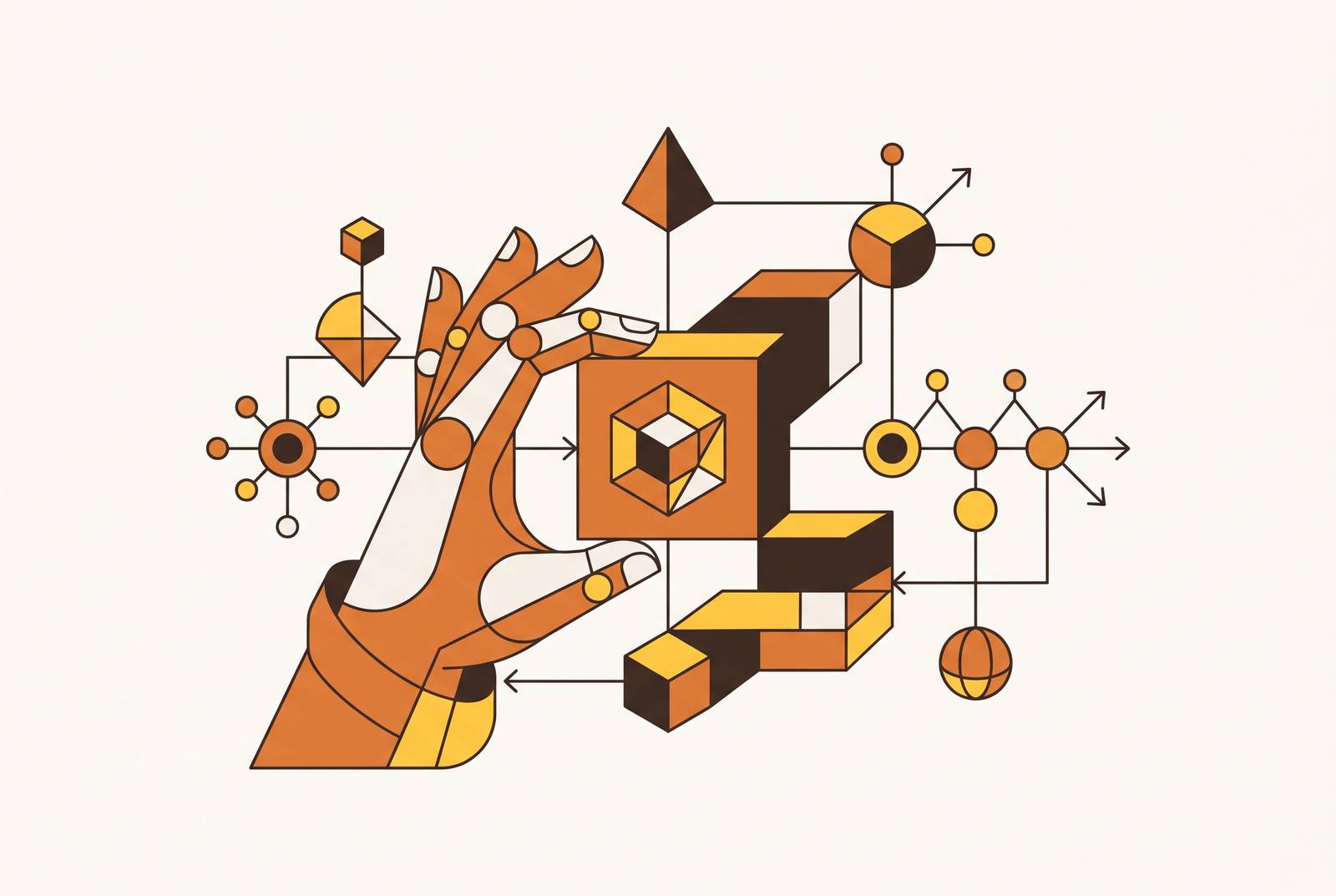
AI has quietly taken over the execution of creative work inside most go-to-market teams, and almost nobody has stopped to draw the line around what it hasn't touched. Slide formatting, monthly report layouts, the fourth landing page template this quarter, all of it moves through AI tools with no real friction. That's the executional layer, and it's been absorbed about as completely as a layer of production work can be absorbed. What hasn't moved an inch is the layer above it: the problem framing, the competitive argument, the reason a particular creative direction fits this particular audience at this particular moment. No prompt generates that, because a prompt is an instruction, and this layer is the thing that decides what the instruction should have been.
The distinction isn't a matter of taste or professional pride. A system trained on millions of slide decks can produce a competent-looking slide deck. It cannot tell you why this customer, in this market, at this moment, needs to hear this particular argument instead of a different one, because that judgment doesn't live in the patterns it absorbed. It lives upstream, in the part of the work that's still entirely human.
The CHI 2025 Tools for Thought workshop synthesis names this shift directly: workflows are moving from production toward what it calls "critical integration," meaning the ongoing human work of deciding when and how to use AI, how to frame the task for it, and how to judge what comes back. The thinking hasn't gone anywhere. It's just relocated to a different part of the process, and teams that don't notice the move keep applying old judgment to a job that no longer needs it, while skipping the judgment the new job actually requires.
Why AI creativity has a ceiling
The human layer is protected by an actual capability gap, and that gap has been measured. Average creativity, in other words, is a target AI can hit or beat. Exceptional creativity is a different animal entirely, and it stayed out of reach.
What it struggles with is the kind of creativity that depends on surprise, on non-algorithmic association, on a framing nobody saw coming because it wasn't sitting anywhere in the training data to be recombined, a different capability than fast output, and conflating the two is exactly the mistake that leads teams astray.
So the ceiling isn't entirely fixed, there's a wrinkle in it. Human prompting skill turns out to be a genuine creative lever, which makes briefing AI well a competency worth developing.
For go-to-market teams, the ceiling appears exactly where you'd expect once you know where to look. It appears in the moment someone has to write the "why now" argument, draw the competitive line that actually differentiates the product, or name the customer's situation precisely enough that the customer recognizes themselves in it, not in the moment a landing page needs reformatting. Those are framing problems, and framing is the part of the ceiling nobody's broken through yet.
The specific risk of delegating too early in the creative process
Twelve slides, clean layout, confident copy, nothing visually wrong with it. And it can still be hollow, coherent as a piece of design while disconnected from whatever argument the business actually needed to make.
The CHI 2025 synthesis names the mechanism behind this design fixation. Polish and soundness are different properties, and a glossy deck has only proven the first one.
Picture the actual mechanics of this going wrong. Recognizing that the thing handed to the model was incomplete before generation ever started is the fix, not a better prompt.
The CHI synthesis also flags that GenAI systems tend to agree with the user's framing. A team that generates the work, reviews it, and approves it, all without bringing in anyone to push back adversarially, is set up to miss exactly the gap between output that looks right and an argument that is right. The review step only works if somebody in the room is actually willing to say no.
How practitioners partition the work
So how do people who've actually lived with this technology for years handle it? Not by treating AI as a co-author with equal standing. They partition the work, deliberately and on purpose, handing AI bounded tasks while keeping a hard line around the decisions that carry the most creative and commercial weight.
A five-year longitudinal study of 17 Chinese digital painters, built on annual interviews running from 2021 to 2025, traced this pattern in detail. Over time, that resistance softened in specific, bounded places. Painters started delegating reference generation, background work, and rough client drafts to AI tools, while holding onto the face, the final pass, and the signature style as territory that stayed theirs alone.
The researchers call this "longitudinal agency partitioning," and the phrase is doing real work. It's a continuous, situated process of redrawing which stages, which responsibilities, and which claims to authorship remain human as the tools keep getting more capable. What separated the two groups wasn't talent or stubbornness. It was whether the partitioning had been made explicit, or left to drift and accumulate by default.
The study also noted that peer norms and production pressure shaped which delegations felt sustainable versus exhausting, which is a useful warning: building the partition into the process itself, rather than relitigating it under deadline pressure every single time, is what keeps the system from drifting toward the second, worse outcome.
Brand consistency as a human governance problem, not a tool feature
Brand consistency at scale is a governance problem wearing a creative costume. A model doesn't know your brand voice drifted two shades toward generic last quarter. It knows what it was told, and it will cheerfully keep producing variations on whatever it was told, drift and all.
The failure mode here is mistaking a generate button for a brand system. What templates can't encode is the judgment call about which message belongs in which context, which tone actually fits which audience, or the moment a visual direction has wandered far enough from the original intent that somebody needs to intervene. That kind of drift is invisible asset by asset and only becomes obvious once a hundred assets are sitting next to each other looking vaguely like they belong to five different companies.
The practical posture that works: lock what can be locked at the workspace level, template what genuinely repeats, and reserve human review specifically for anything carrying brand voice or competitive positioning, since that's where drift compounds silently. The CHI synthesis backs this up from a different angle, identifying homogenization as a structural risk of GenAI output: systems tend to flatten creative work toward sameness, an effect that gets worse the less a team understands the model's subtle limitations. Brand distinctiveness doesn't survive on guidelines loaded into a prompt. It survives on active human intervention, repeated.
For teams building in-house creative capacity without a dedicated design department, this reframes what a designer's most valuable contribution actually is. It's not producing the hundredth asset. Moda's model is built around exactly this idea, locking brand elements at the workspace level so that whoever's generating a one-pager at 11pm before a sales call is working inside a governed system rather than improvising decisions they were never equipped to make.
Emotional and contextual intelligence as the competitive edge in go-to-market creative work
Researchers have a term for what AI tends to produce under pressure: plausible pastiche. Coherent, pattern-consistent, technically fine, and missing the texture that comes from someone actually thinking through a problem rather than recombining what thinking has looked like before.
So what actually separates a strong go-to-market professional from a merely capable one, now that execution is table stakes? Strategic framing of the problem. It is the ability to look at AI output and judge it against the real business case. Notably absent from that list: graphic design and copy drafting, both of which AI now handles competently enough that competing on them is a losing bet.
The digital painting study turned up a finding that maps onto this almost exactly. In go-to-market terms, the equivalent claim is the one that matters most: that the argument in front of the customer reflects a genuine understanding of that customer and that market, not a well-dressed guess.
None of this means the human layer is shrinking. If anything it's concentrating, getting smaller in surface area and higher in stakes, which is arguably a better trade than it sounds like. The people who understand exactly where that split falls, and who put real effort into the judgment and insight that sit on the human side of it, are the ones whose work will be distinguishable from the broad middle of AI-assisted sameness everyone else is producing.
Structuring a creative workflow that gives AI the right inputs and keeps humans at the right decisions
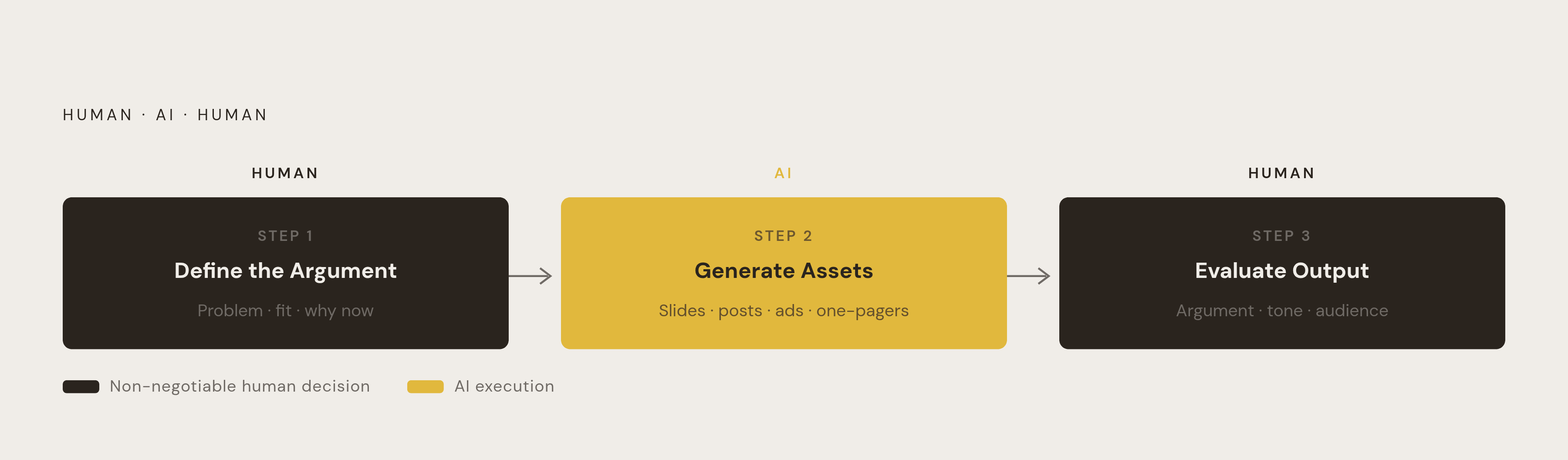
An effective workflow treats AI as a highly capable executor of a well-defined brief, not as a thinking partner for a problem nobody's defined yet. That ordering affects outcomes directly: the human work of nailing down the brief, the argument, and what success looks like has to happen before generation starts, not as a cleanup pass afterward.
Step one is entirely human, no shortcuts available. Establish the actual argument before a single asset gets generated: what problem the audience actually has, why this solution fits it, and why now matters. AI can't infer any of that from a prompt, and no amount of downstream design polish rescues a deck or a one-pager built on a weak argument. This is the step teams skip when they're in a hurry, and skipping it undermines everything that follows.
Step two is where AI genuinely earns its keep. That speed compounds, especially across a campaign where the same core argument has to reappear, reworded and reformatted, across slides, social posts, one-pagers, and ads. This is the execution layer from the first section, doing exactly the job it's good at.
Step three hands the decision back to a human. Evaluation here isn't "does this look good," it's "does this make the argument, in the right tone, for this specific audience," and that's a contextual judgment call no model can run on itself. It can't tell you whether the CFO in the room cares about the metric you led with.
For teams running this on a platform like Moda, the three steps aren't three separate tools stitched together awkwardly. Brand governance gets set upstream by whoever owns the brand, AI generates assets onto an actual editable canvas rather than a flat image file, and the operator or salesperson makes the final calls on message fit and context before anything goes out the door. There's no black-box render to work around and no static image that needs to be thrown out and regenerated from scratch the moment the argument shifts slightly, which it usually does.
The Montreal research found that how instructions are written changes what AI produces, materially. That makes learning to brief AI well a real professional skill, not a workaround or a stopgap until the tools get better. Teams that invest time in getting good at this get measurably better results out of the exact same tools everyone else is using, which is a fairly good argument for treating the brief itself as the place where the real craft now lives.
Sources
- Understanding, Protecting, and Augmenting Human Cognition with Generative AI: A Synthesis of the CHI 2025 Tools for Thought Workshop
- Material for Thought: Generative AI as an Active Creative Medium
- Where Does the Human End? Creative Agency with Generative AI across Five Years of Chinese Digital Painting
- Has the Creativity of Large-Language Models peaked? An analysis of inter- and intra-LLM variability
- The paradox of creativity in generative AI: high performance, human-like bias, and limited differential evaluation
- The Role of Human Creativity in the Presence of AI Creativity Tools at Work: A Case Study on AI-Driven Content Transformation in Journalism