AI-Generated Slides vs Human-Designed Decks in Sales Contexts
The choice between AI and human-designed decks depends entirely on what the deal actually requires.
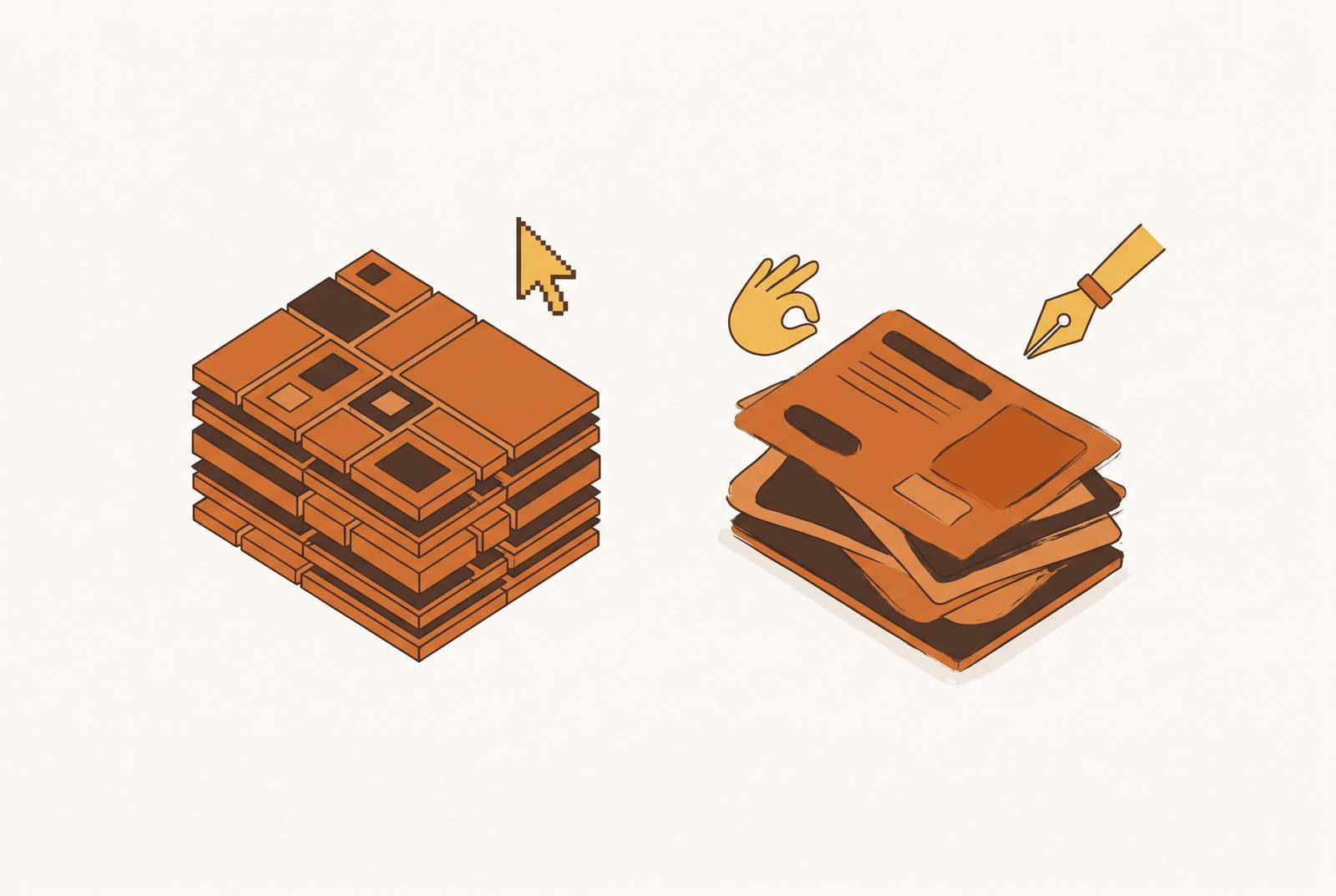
Sales teams keep asking whether AI or human designers make better decks, and that question has no answer because it's the wrong one. The real split is situational: some deals need speed and volume, others need deliberate, buyer-specific storytelling that a template can't fake, and the job is knowing which is which before you start building.
The AI-vs-human framing is the wrong question for sales teams
A sales deck isn't a fixed artifact you build once and reuse. Prezi's 2026 guide describes it as a living document, one that shifts with every deal, every prospect, and every stage of the buying journey. That framing alone breaks the AI-versus-human debate, because a living document doesn't have a single correct production method. It has different needs at different moments.
Both answers turn out to be right in their own context. Neither one is a policy. A policy that says "always use a designer" fails the moment a rep needs forty persona variants out the door by Friday. What follows maps out which situations call for which approach, using the actual signals that separate a deal needing speed from one needing judgment.
What AI-generated decks genuinely do well in sales contexts
Start with the boring part, because the boring part is where AI wins outright: recurring reports, first-draft proposals, high-volume outbound, persona variants. For this slice of sales work, AI generation is structurally the better option on speed, consistency, and cost, not a workaround for lacking a design team, and pretending otherwise just slows everyone down.
The speed numbers back this up. 2Slides' 2026 platform data shows average creation time running at a fraction of what manual deck-building takes, with a complete, professionally designed deck coming together in seconds rather than the hours a designer would need to lay out the same thing by hand. Consistency follows the same logic: AI enforces uniform typography, spacing, color palettes, and heading hierarchy across every output, which solves the "every deck looks different" problem that shows up constantly in sales orgs without strict design guidelines. 2Slides is candid about this being one of the clearer wins for the technology.
Then there's personalization at volume, which is arguably the sharpest sales-specific advantage on the list. Prezi's 2026 guide points out that generating a unique deck for each prospect, pulling in company-specific framing and a tailored value proposition for each one, is something only AI can realistically do at scale. No design team is writing forty custom intros by hand before lunch. Modern sales enablement runs on modular assets anyway: a core deck plus persona variants, objection-handling slides, competitive inserts, swapped in and out depending on who's in the room. AI keeps that whole library current at a pace no human team matches.
For the rep who isn't a designer, this is maybe the most practical shift here. 2Slides' 2026 decision guide notes that engineers, analysts, and account managers can now produce polished decks without any design background, which quietly levels a playing field that used to require either a design degree or a design department. The output isn't a flat image frozen in place but a real, editable canvas, so the rep can still adjust every element to match the buyer and the brand instead of accepting whatever the AI handed back as final.
Where AI-generated decks fail in front of buyers
So why doesn't this solve everything? AI decks don't usually fail because they look bad; they fail because they look like no one in particular made them, and buyers in high-stakes deals notice that absence the way you'd notice a stranger wearing someone else's name tag.
Over-consistency, not ugliness, is the actual perceptual problem. 2Slides' 2026 analysis lists the tells: a uniform typographic rhythm that never varies, an over-saturated illustration style, stock-placeholder imagery, generic phrasing, layouts so clean they have zero visual hierarchy. That same source notes that audiences have learned to spot the absence of those traces. An AI deck often reads as "fine." It rarely reads as powerful, and in a deal where the buyer is deciding whether to trust you with real money, blending into the background is a liability dressed up as competence.
Underneath the aesthetic risk sits a sharper one: hallucination, where prompt-only AI tools without grounding in real data can generate figures, names, or claims that simply aren't true, and a fabricated number in front of a procurement committee ends the conversation on the spot. The fix isn't complicated: use AI for structure and language, then manually verify every numeric claim against CRM data or whatever primary source actually backs it. Skipping that step means gambling the deal on autocomplete.
Tone is its own trap. AI can misread the emotional register a slide is supposed to carry. Picture a deck announcing layoffs arriving with cheerful, high-energy stock visuals; 2Slides flags exactly this kind of mismatch as a known failure mode, and it's the sort of thing a human catches in two seconds and an algorithm doesn't catch at all. Highly technical content runs into a related problem: nuance gets flattened, industry-specific language gets misused, and in a technical sale, that kind of error reads as not understanding the buyer's world well enough to sell into it.
None of this is random. These failures are predictable. They're avoidable, provided you know what to check for before the deck goes out the door. That's the real value of naming them: not to scare anyone off AI tools, but to build a checklist.
The five signals that tell you a deal needs human judgment in the deck
Run these against your next deal. If two or more apply, hand the deck to a person before it goes to a buyer.
Stakes are existential for the buyer. A procurement team weighing a six-figure contract, or a founder sizing up a strategic partnership, isn't just comparing feature lists; they're reading your effort as a proxy for your judgment, and a deck that reads as generated sends exactly the wrong signal at exactly the wrong moment.
The presentation is the product. 2Slides' 2026 decision guide makes this point directly.
The deal has no room for a flattened nuance or a misused term. If your buyer will clock a mangled piece of industry jargon in three seconds, the deck needs someone fluent in that world reading it before it ships.
The narrative needs emotional contrast or a deliberate surprise. Some decks need tension, a pause, a moment where the rhythm breaks on purpose, a slide that goes quiet before the close lands. Knowing when white space works harder than another bullet point, and knowing when to break a pattern instead of repeating it, is interpretive judgment. AI doesn't make that call because it isn't a creative choice to the model, it's just the next most likely layout.
Brand compliance gets audited, not approximated. When a design system is enforced with real scrutiny, pixel by pixel, human designers are the ones who guarantee every rule holds. AI can get close. 2Slides' 2026 decision guide is blunt that "close" isn't the same as guaranteed compliance.
The obvious objection here is cost: "We can't put a human designer on every high-stakes deck we run." Fair, but that's not actually the tradeoff. The hybrid workflow below handles this by having AI cover the mechanical first draft and a human handle only the narrative layer and the moments that matter, which cuts the time cost down to a fraction of a fully manual build.
How a sales team runs the hybrid workflow
In practice, the best-performing sales decks aren't produced by AI alone or a designer alone. They come out of a staged sequence where AI handles the mechanical layer and a human governs the handful of moments that actually decide whether the buyer moves forward.
AI produces the structural draft, the layout, and the first pass of copy in seconds rather than hours in stage one, generation. Stage two is where a human takes over the story itself. Slide order gets reshuffled for narrative logic, the messaging gets sharpened for the specific buyer in the room, and the tone gets corrected for whatever emotional register the deal actually calls for. This step typically takes minutes, not hours, because the AI already did the heavy lifting on layout.
Stage three is unglamorous and non-negotiable: every numeric claim in the deck gets checked against CRM reports or whatever primary data backs it, before the deck leaves the building. Treat every AI-generated figure as a placeholder until someone confirms it's accurate. This step prevents hallucinated figures from Section 3 from ever reaching a buyer's screen.
Stage four, reserved for the highest-stakes decks, is where deliberate imperfection gets added back in. The opening and closing slides, especially, get rewritten in first-person voice, and one or two elements get made intentionally human: a real photo from the team's own environment, a pull-quote set at a size nobody would auto-generate. 2Slides' 2026 analysis frames this as the step that makes a deck read as authored. It's a small move, but it's the one that answers the over-consistency problem directly.
Put together, 2Slides' 2026 decision guide puts the whole sequence at one to two hours total, and claims it produces better consistency than a fully manual process that would otherwise run six to eight hours. Shipping one high-stakes deck a week versus shipping five comes down to this time saved. The division of labor scales naturally too: designers set the brand system and lock the core elements once, and reps or marketers generate variants inside that system without creating a bottleneck on every single deal.
What this means for teams choosing a design platform
None of the four stages above work if the platform hands you a flat image at the end. A static output or a locked template breaks the workflow exactly at Stage 2 and Stage 4, the two steps where a human needs to actually touch the thing: reorder slides, swap language, drop in a real photo, resize a pull-quote. If the AI's output can't be opened and changed at the element level, the hybrid model collapses back into the binary choice this whole piece started by rejecting.
That's the actual question to ask a design platform, and it's a more useful one than "how fast does it generate": how much can you change after it generates? A tool that produces something gorgeous in four seconds but locks every layer is solving the wrong problem for a sales team, because speed without editability just means a different flavor of static output. Brand consistency at scale needs a system, not a one-off template: designers lock the core elements once, and the rest of the team populates variants inside that structure, which is what actually makes a modular sales deck library survive contact with forty different prospects.
The editability argument is the whole point. Moda's core claim is that AI-generated design only earns its keep when every element stays under the user's control, layout, imagery, hierarchy, brand assets, all of it adjustable without opening a second tool or filing a ticket with a designer. It's the condition that makes Stage 2 and Stage 4 possible at all, the same reason the tone-mismatch and over-consistency risks from Section 3 are fixable rather than fatal: a rep or marketer can recalibrate the visuals and the message by hand once the AI has done the fast part.
The platform decision and the workflow decision turn out to be the same decision. A tool that locks its outputs quietly commits you to the AI-only path, with all the risks that come with it. A tool that treats every generated deck as a working file keeps the option to apply human judgment exactly where the five signals say you need it, without giving up the speed that makes AI worth using in the first place.