Design Budget Allocation for Seed to Series A Companies
Strategic design spending at each stage unlocks different outcomes, not just prettier pixels.
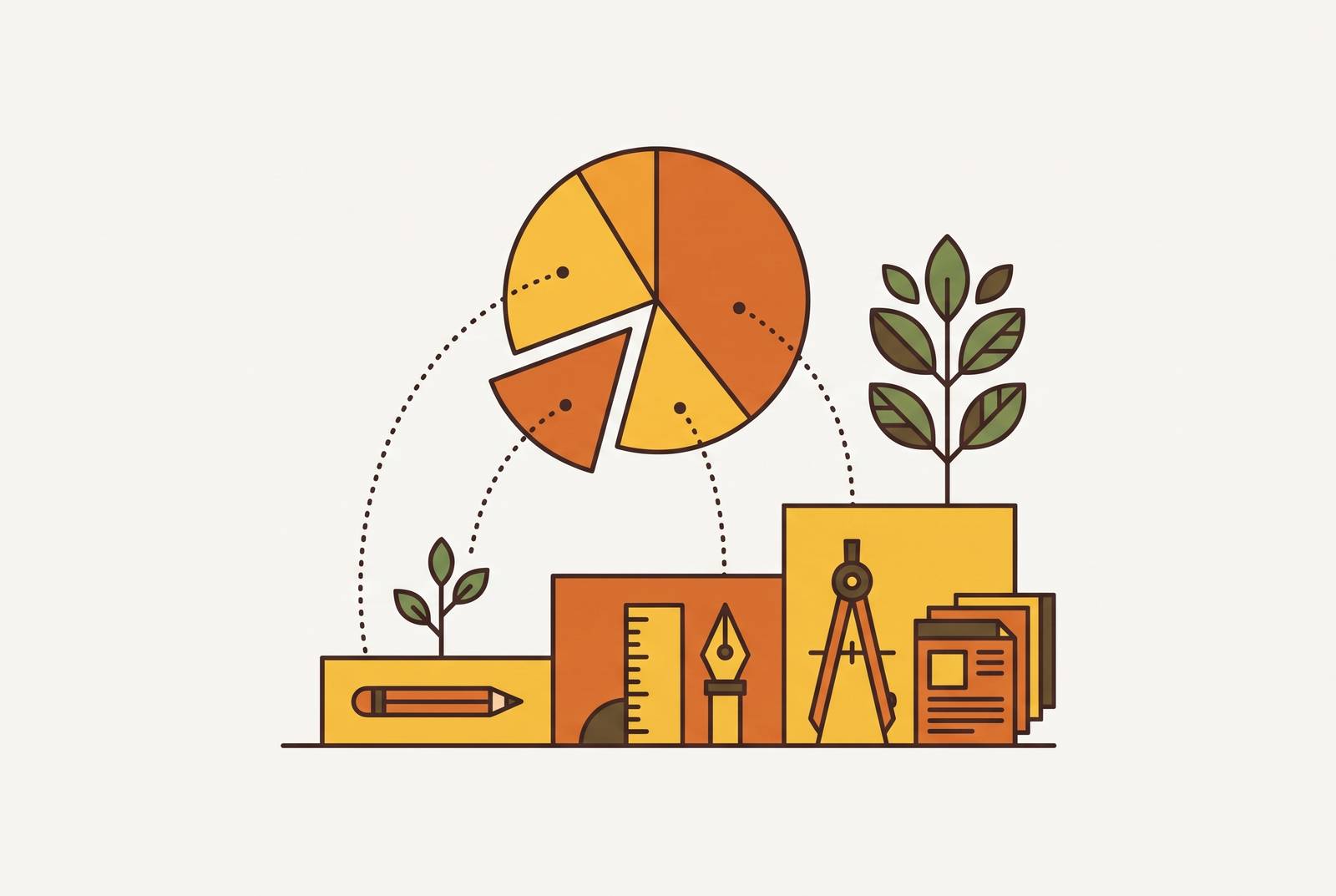
Design budget allocation from seed to Series A is a sequencing problem, not a percentage problem: what has to be true about your company at each stage determines what design is supposed to prove, and most founders skip that question entirely and go straight to "what's left over after engineering and sales get paid.
That instinct is understandable. Design feels soft when the thing you're building is hard (literally, in the case of hardware). But treating design as a leftover line item is how companies end up with a seed-stage landing page still bolted to the website at Series A, or a Series A design budget spent polishing a logo nobody outside the founding team has opinions about. This piece is the corrective: a framework for matching design spend to what the stage actually requires, category by category, dollar by dollar.
Design budget decisions at seed versus Series A
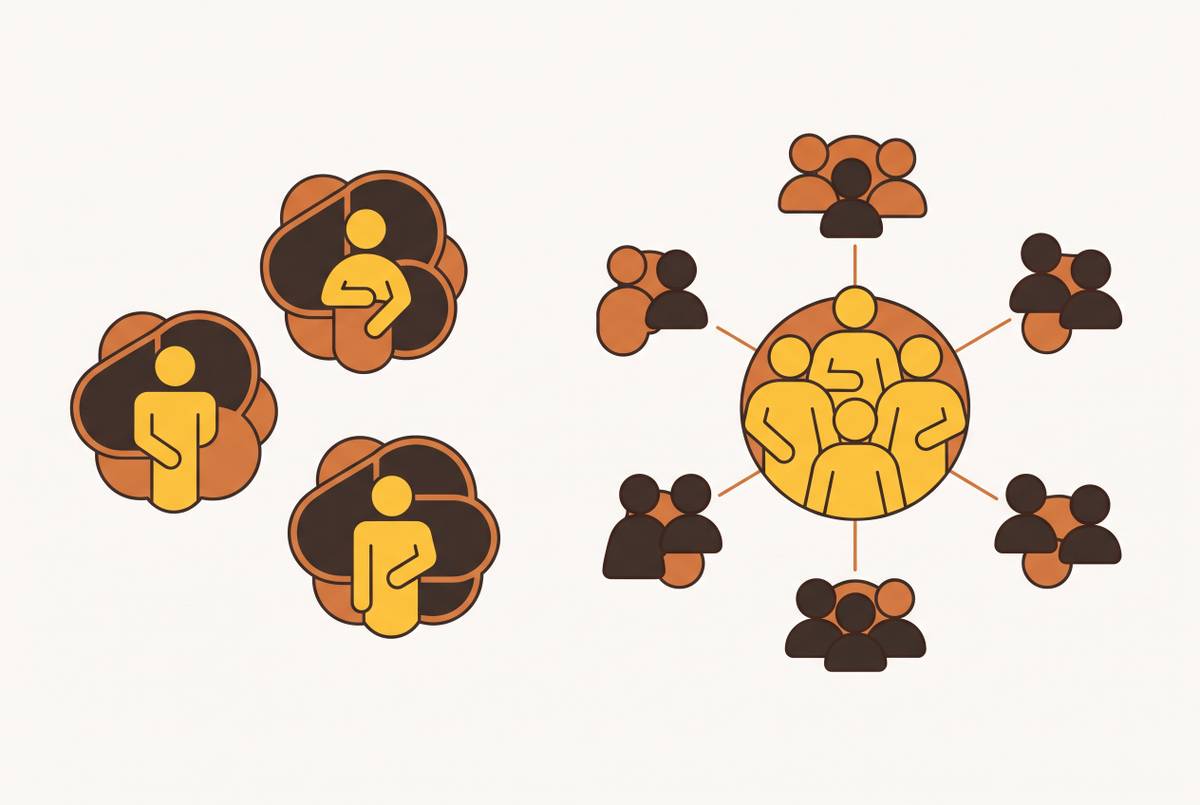
At seed, design has exactly one job: prove the company is real and the idea is worth believing in. The audience is small, a handful of early adopters kicking the tires and a few angels who've seen enough pitches to smell desperation. Design at this stage answers "are these people legitimate?" and nothing more ambitious than that.
Series A flips the audience completely. Nobody says that part out loud in due diligence, but a scrappy visual identity at Series A reads less as "scrappy startup charm" and more as "this team hasn't gotten its act together yet," fair or not.
The practical consequence cuts both ways. What counts as "enough" design at seed would embarrass you in an enterprise procurement review at Series A. Seed marketing budgets typically run 10 to 20% of funding under 2026 guidance, which is a tight ceiling. That forces real triage on every design dollar, and triage only works if you know what you're triaging for.
Marketing and design share of the raise
Before splitting design dollars into categories, it helps to know the size of the pool they're coming from.
In absolute dollars, the gap is even starker than the percentages suggest, because the percentages apply to very different raise sizes. A Series A budget scales up substantially, not just because the percentage grew but because the base it's drawn from did too.
Design rarely gets its own line in these envelopes, so the fix is to treat design spend as two separate pools rather than one blurry category. Conflating the two is how a founder justifies a five-figure brand overhaul in month two and then has nothing left for the ad creative that was supposed to prove the business model.
What seed-stage design dollars must accomplish
Every seed design dollar has one job: generate the data and credibility that validates go-to-market hypotheses and strengthens the next fundraise. Not a polished brand. Not a cohesive multi-channel identity system. Validation, and the receipts to prove it happened.
In practice that means a minimal but credible web presence, just enough to pass the "are these people real?" test for early buyers and angels. A landing page, not an SEO content operation with a blog cadence and a keyword strategy. Spending three months and five figures perfecting a visual identity before you know that is optimizing the wrong variable.
It also means leaning hard on founder-led LinkedIn and social presence, because the distribution math favors it: a founder's personal profile reaches a meaningfully larger share of a target audience than a brand-new company page with zero followers and zero history. At seed, the founder is the brand, whether that founder signed up for it or not.
What seed design should not fund yet is a full brand strategy engagement, a custom website with real engineering infrastructure behind it, or a dedicated in-house designer before product-market fit is established. None of that is wrong, exactly. It's just early, like buying snow tires in July. The dominant seed budget category isn't design at all, it's paid acquisition testing and the analytics stack needed to interpret what that testing is telling you. Design's job at seed is to support those experiments quietly from the sidelines, not to compete with them for dollars.
The five design categories at Series A
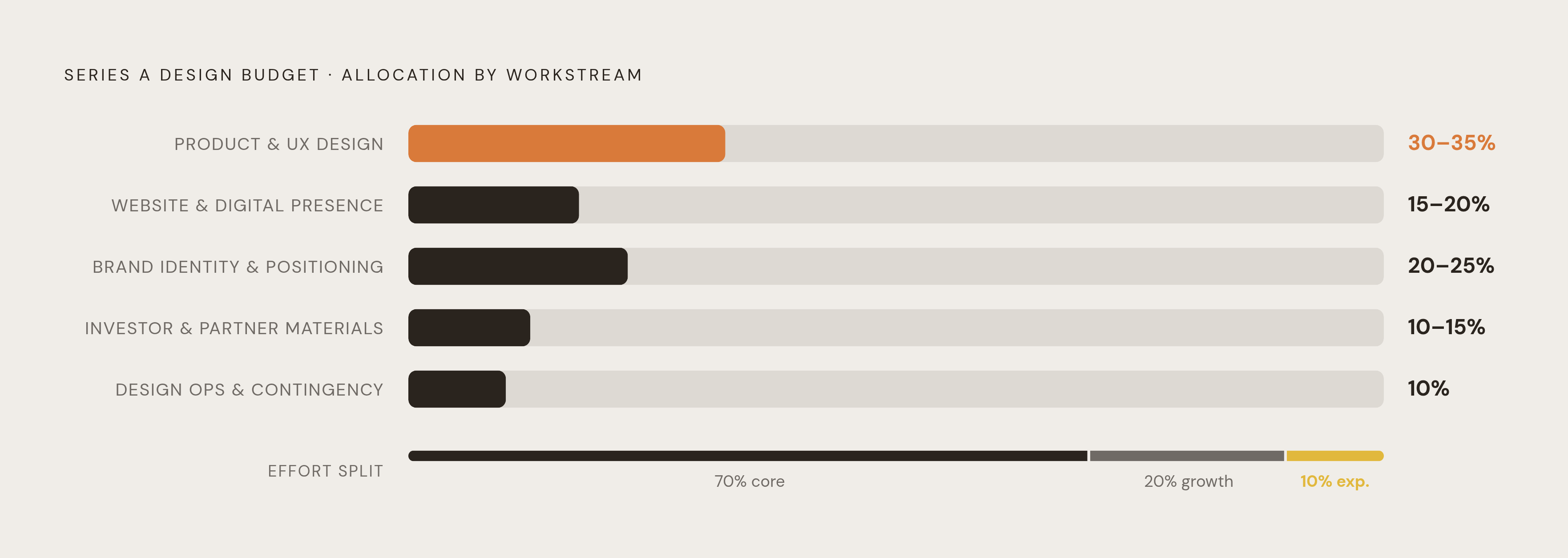
At Series A, design splits into five distinct workstreams, each serving a different audience and each capable of creating a visible hole in the funnel if it's ignored.
Product and UX design takes the largest share, roughly 30 to 35%, because usability drives retention and expansion revenue in a way that's measurable in cohort data within a couple of quarters.
Website and digital presence runs roughly 15 to 20%. That seed-stage landing page, the one that did its job admirably for a year, will not survive enterprise scrutiny or a partner's due diligence checklist. Series A websites need to support SEO-driven content growth, technical documentation for integration-minded buyers, and credibility signals for channel partners deciding whether to co-sell. This is a recurring budget line, not a project with an end date.
Investor and partner materials take roughly 10 to 15%: decks, case studies, buyer-ready collateral for board members, prospective Series B investors, and partners whose logo is going to sit next to yours in a press release. Treating this as a cost center produces decks that look exactly like what they are, an afterthought stapled together the week before the board meeting.
Ongoing design ops and contingency get roughly 10%, reserved for continuous iteration, the scope shifts that happen the moment real stakeholders react to real work, and the ad creative refresh cycle. Creative fatigue degrades even the best-performing ads within weeks once spend scales, so a design ops line that can't keep pace with campaign burn becomes a performance marketing problem wearing a design costume.
Layered over all five categories is a 70/20/10 effort split: roughly 70% of design effort goes to core deliverables (the brand system, core product screens, the main website), 20% to growth and enhancement work like campaigns and conversion optimization, and 10% to experimentation, defined on one industry benchmark page as testing new formats and scope that might not pan out.
For climate, deep tech, or hardware companies, push extra budget toward brand identity and website specifically. Enterprise sales cycles and competitive brand pressure in a crowded category both push a company toward the high end of these ranges, so treat the percentages as a framework to adapt rather than a formula to apply blind.
The single highest-leverage deliverable in this whole category list is the investor deck, and it deserves separate attention because founders routinely underbuild it relative to what it's worth. Design's actual job on each slide is to make the signal legible and credible, not to decorate it with gradients.
The smartest operators build two versions. An asynchronous version carries detailed notes, clear data visualization, and a narrative flow that walks an investor through the logic without a founder in the room to fill gaps. Both versions belong in the 10 to 15% investor materials bucket, but the deck has to stay a living, editable asset rather than a locked PDF, because a deck built on static files breaks the moment the story needs updating before a board meeting, a partner call, or Series B prep.
How AI tooling changes output-per-dollar math for early-stage design
Something has genuinely shifted in what a non-designer can produce without hiring anyone. Given a structured brief, a token file, and a brand rule set, an AI agent returns a real, editable business asset, with none of a generic template's serial numbers left on it. That turns the budget decision into a question of what system to build and where human judgment still has to sit.
The gains concentrate in specific workstreams: generating assets across formats and channels (social posts, one-pagers, ad variations), running A/B tests on creative without a proportional jump in design labor, and producing localization or accessibility variants at scale. These are volume problems, and AI tooling is, at bottom, a volume solution.
But automation amplifies whatever foundation it's running on top of, for better or worse. The system has to exist before it can be delegated to a machine.
One senior Design Lead whose job is protecting the brand and building that system, supported by AI-assisted production for the volume work, is the staffing model that fits this stage. Not a sprawling in-house team, and not a full-service agency retainer eating the Series A design budget whole. One person owning the judgment calls, with machines doing the repetition underneath them.
LinkedIn and social content as a design budget line item
LinkedIn format choice is a budget allocation decision, because different formats produce measurably different engagement rates and design time is finite. Treating format choice as a creative whim rather than a resourcing question leaves engagement on the table for no good reason.
The numbers are specific enough to plan around. A practical weekly content mix for growth-stage B2B SaaS companies leans heavily on founder-led text posts, carves out roughly 25% of the mix for native documents or carousels, and fills the rest with short founder videos, proof posts or diagrams, and occasional event or offer distribution.
Carousels and native documents don't design themselves. They require actual designed assets, slide by slide; this is not zero-cost content no matter how organic it looks in the feed. At Series A, that work sits inside the ongoing design ops category outlined earlier, and it should be resourced from that line directly rather than scraped together from whatever's left in contingency once something else runs over budget.
Choosing between in-house, agency, freelancer, and platform for each category
The execution model is five separate decisions, not one decision applied uniformly across the whole design budget, because the five Series A workstreams carry different risk profiles, different quality bars, and wildly different volume patterns.
Brand identity and positioning is high-stakes but low-frequency, done once and revisited rarely, which makes a freelance specialist or small studio better value than a full agency retainer at most Series A budget sizes. Ongoing design ops and ad creative is where AI-assisted production platforms earn their keep most clearly, letting go-to-market teams turn out on-brand assets without looping in a designer for every single iteration.
Agency critics raise a fair objection to leaning too hard on AI production: strip out human creative direction and AI-generated output starts looking interchangeable, one brand indistinguishable from the next. Strategic and identity work specifically still needs a human making calls about direction, positioning, and what the brand should actually say out loud. That's a reasonable challenge, and the answer isn't to abandon AI tooling over it. It's to be precise about which decisions stay human. Brand direction, narrative positioning, and the choice of what not to say don't delegate well to any system, however good its token file is.
The five categories and both stages point to one underlying cause: execution model gets chosen by workstream, not by founder preference, and the data bears this out. The best-run design budgets, seed or Series A, match execution model to workstream, build a system that stays editable rather than a drawer full of finished files nobody can touch without the original vendor, and keep the founder's hand on the story at every single stage of the raise.