Embedded Designer vs Shared Services Model for Marketing Teams
Choosing between embedded and shared design models depends on identifying your actual bottleneck.
What "shared services" means in practice, and where it holds up
Most marketing teams pick a design operating model the way they pick a health plan: fast, under pressure, and mostly guessing. That choice, embedded designers versus a shared services team, should function as a diagnosis of where the actual bottleneck sits in the marketing motion. Skipping the diagnosis means the org ends up solving the wrong problem at full price, and the bill doesn't arrive until two quarters later when someone finally asks why output didn't move.
That failure pattern appears throughout marketing spend, not just design. A team burns $180,000 on paid media when the real leak is a gap between signup and activation. Another hires a VP of Growth at $220,000 fully loaded, hands them no engineer and no data infrastructure, and then growth never materializes. Same root cause both times: the org bought a solution before it named the constraint. Design model decisions follow the identical script. Structure gets picked first, the bottleneck gets discovered second, which is backwards and expensive and, frankly, the default setting for most companies.
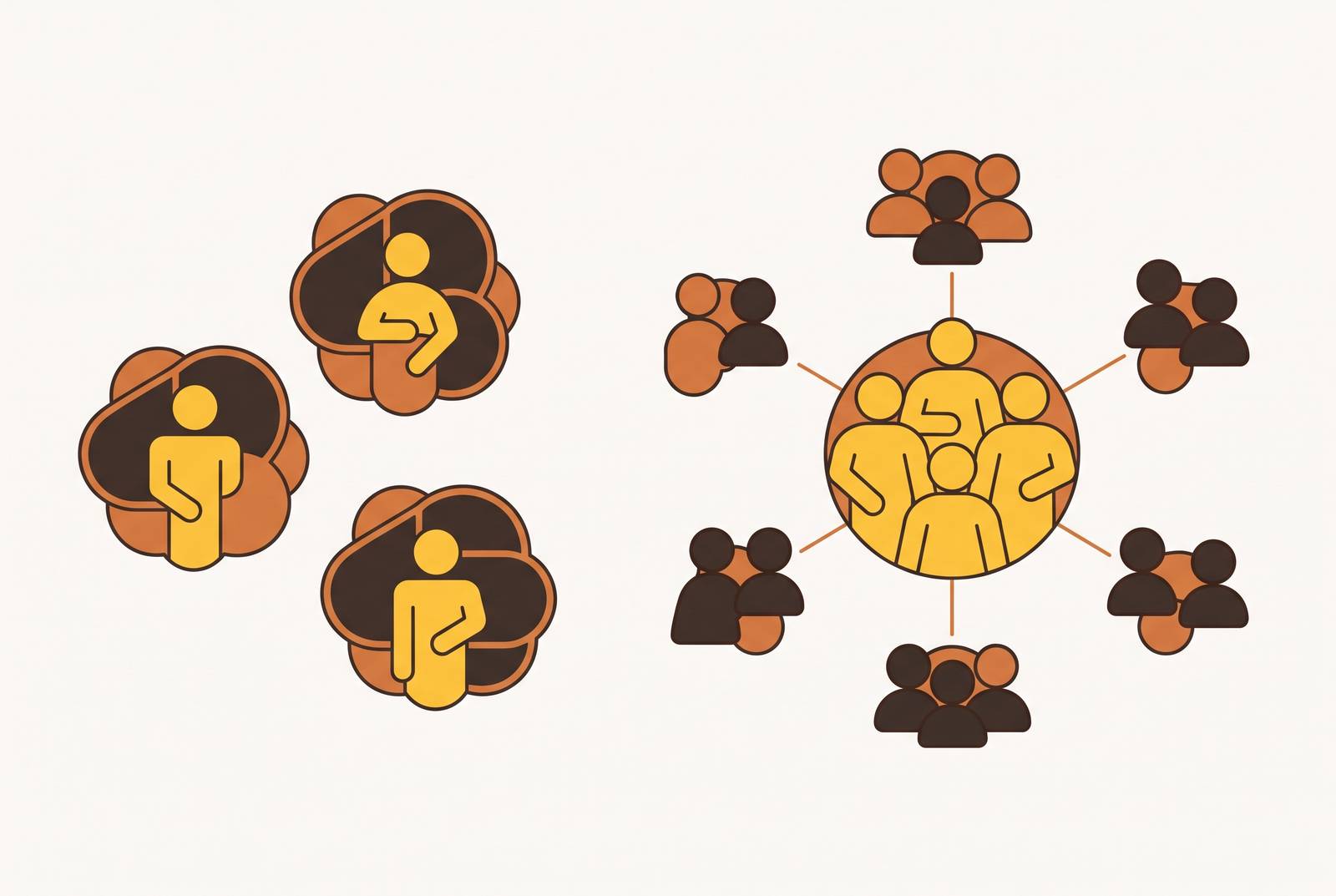
Shared services means design operates as one function everybody else routes requests into. Marketing submits a brief, product submits a brief, sales asks for a one-pager for a deal closing Friday, and it all lands in the same queue, worked by the same designers reporting up through one design lead instead of scattered across the business.
This model earns its keep in specific, identifiable places. Brand consistency is the obvious one: ten designers sitting near each other absorb the same visual language by osmosis, catch each other's departures from it in review, and keep a hundred campaign assets from looking like they came from a hundred different companies. Craft development follows the same logic, since a designer who only hears feedback from a marketing manager improves slower than one getting weekly critique from someone who's spent a decade in the discipline. The operational upside is real too: one intake process, one priority queue, one shared component library, instead of five departments each reinventing the request form from scratch.
Centralized teams fit best where governance and creative control across many touchpoints require holding the brand together at the center, or it frays at the edges nobody notices until a partner asks why the last three campaigns don't look related. That's a genuine trade-off, not a hedge. A company running a hundred simultaneous small campaigns across regions and channels needs the brand held together at the center, or it frays at the edges nobody's watching.
The model breaks the moment volume outpaces the queue. Once marketing, product, and sales are all fighting for slots in the same pipeline, capacity becomes the bottleneck, and the queue turns into the loudest voice in the building. Designers stop shaping the work and start receiving it: brief in, asset out, on a timeline set by whoever else is waiting in line. At that point design is a production line wearing a nicer job title, because the strategic function has already given way to pure throughput.
What "embedded designer" means, and the problem it was built to solve
An embedded designer sits inside one team, growth, brand, lifecycle, whichever function needs one, and works against that team's priorities directly instead of pulling tickets from a shared queue. No intake form, no waiting for a slot. The designer is in the room when the campaign gets planned, not handed a summary of it afterward like a memo from a meeting they missed.
That proximity closes a gap shared services can't close by design: the context gap. A designer embedded on a lifecycle team knows the churn number the emails are supposed to move, knows which segment is being targeted and why, knows what the last three tests actually showed. A designer pulling a brief from a central queue knows what the brief says, and nothing else. That difference sounds small on paper, and it appears in every single output regardless.
Speed follows naturally, since there's no ticket, no cross-team handoff, no waiting for the queue to clear. The more consequential shift is timing: an embedded designer gets pulled into the thinking before the campaign is finalized, shaping what gets built instead of decorating what's already been decided. That's the real mechanical difference between embedded work and an agency relationship or a shared services queue. Embedded designers answer to a number in the plan, activation rate, conversion, pipeline generated, not to a deliverable checked off a brief. They sit inside the leadership rhythm, in the standups and planning sessions, rather than waiting beside it for a request to arrive. And they tend to own diagnosis and measurement alongside execution, which is a very different job than making the banner ad look nice.
The growth stage at which each model tends to break
Marketing organizations tend to move through three recognizable phases. Founder-led, roughly zero to two people, where whoever's around does the design because there's no one else. Specialist, three to fifteen people, where roles start splitting out. Pod-based, fifteen-plus, where marketing runs as semi-autonomous units, each owning its own metrics.
Most teams hit the break point at the transition into the specialist phase, usually somewhere around five to seven headcount. Generalists who used to handle a bit of everything become the ceiling on output, and the instinctive fix, hiring more generalists, tends to add coordination overhead instead of throughput. More cooks, same kitchen, longer wait for the food.
Shared services holds up well through the specialist phase precisely because the team stays small enough for one centralized function to serve everybody without the queue collapsing under its own weight. Brand consistency also affects how the company is perceived in market, since the company is still establishing what it looks like there, so it takes priority over speed on any single request. Volume stays manageable enough that one design lead and a handful of designers can genuinely see everything going out the door.
Embedding starts to make sense once the org hits the pod phase, fifteen-plus people organized into units that each own a number. At that point, a growth pod chasing an activation metric and a brand pod protecting positioning are running fundamentally different games on fundamentally different clocks. A shared queue serving both starts to look like one referee trying to officiate two games happening on the same field at the same time. Pods at that stage need design living inside the motion, not orbiting outside it waiting for tickets to clear.
Why the hybrid and embedded-partnership models are not a compromise
Neither model above is the end of the list, and treating this as a binary choice is where most of these decisions go wrong. A hybrid structure keeps one senior, well-paid in-house design lead whose job is protecting the brand, then routes heavy execution work out to an external partner. The internal lead sets standards and reviews output. The external team functions as an on-demand production layer, absorbing volume without adding permanent headcount.
Embedded partnership differs from a traditional agency relationship because the outside team gets pulled into strategic conversations far earlier than a normal agency engagement allows. That's a mindset shift more than a seating chart. The partner isn't waiting for a brief to land in an inbox; the partner is in the conversation where the brief gets formed.
This setup solves problems a pure in-house build genuinely cannot solve on its own, and calling it a compromise misses what it's actually doing. Programs needing a burst of execution capacity for a defined window don't justify a permanent hire, and an embedded partner scales up for that window and back down without a layoff conversation. Skill breadth is another gap it fills: no single in-house designer covers motion design, UX writing, paid creative, and developer handoff at a high level all at once, so an external partner covers whatever the internal team can't. There's also a slower risk fully internal teams run into, an echo chamber effect, where the same five people looking at the same references produce work that increasingly only makes sense to those same five people. An outside partner, working across other clients and other categories, brings in a perspective that would not otherwise appear in the room.
Keeping strong creative talent inside an in-house agency has historically been hard, and it gets harder exactly when budgets tighten at the same moment new skill sets become necessary. Hybrid and embedded-partnership structures function, in part, as a hedge against that hiring problem. Calling them a middle ground undersells what they're actually built to fix.
The insourcing shift and its effect on the math
The move toward in-house design has been building for a while, and the numbers back it up. The Association of National Advertisers found 82% of member companies reported having an in-house agency, up from 78% in 2018, a real trend line, not a fad. That's a real trend line, not a fad.
AI is pouring gasoline on it. Sixty percent of US senior marketing leaders said in 2025 that they spend less on agencies specifically because of AI. Agencies are already feeling the contraction: an average 8% headcount cut across agencies in 2025, with Forrester forecasting a further 15% reduction in agency jobs in 2026. The drivers line up with what anyone watching procurement conversations would expect: low-margin project work replacing retainer relationships, tighter procurement scrutiny, and AI chipping away at the labor-intensive model agencies have run on for decades.
In-house leaders should be nervous rather than smug about one thing. Forrester also found 61% of agencies currently use generative AI in their marketing work, compared to just 17% of in-house agencies. So the insourcing wave is accelerating at the exact moment external partners are, on average, far more AI-capable than the in-house teams absorbing the work they used to send out. This is not really a contradiction; it is a lag: the economic incentive to bring work in-house is moving faster than the operational capability to do it well once it lands there. Companies are insourcing into a capability gap and calling it a cost saving.
How AI-assisted design tools change what each model needs from a human designer
AI tools make execution cheap and plentiful. They don't decide what should get built in the first place, and show no sign of doing so soon, nor do they judge whether the output is actually right for the moment it's meant to serve. That distinction is the whole ballgame. The real concern circulating among designers isn't that AI replaces them, it's that AI makes weak design look finished enough to slide past review, which is a much sneakier problem than obsolescence ever was.
That risk lands differently depending on the model, and this is where shared services quietly earns back some of the ground it loses on speed. A shared services team, with a senior design lead reviewing work across the whole queue, tends to have more trained eyes on output before it ships, which can limit polished-but-wrong work from clearing review unnoticed. An embedded designer, especially one who's the only creative voice on a pod, doesn't have that backstop. If that designer's judgment is off one week, or the AI tool nudges something toward "reads fine but isn't," there's no second reviewer standing between that output and the audience.
Where AI genuinely helps the embedded model is by compressing the execution layer: layout work, variation generation, first-pass copy drafts, freeing the embedded designer to spend more of the day on judgment calls and strategic input, which was the entire point of putting them inside the team to begin with. For shared services, AI's biggest contribution is chewing through the repetitive, high-volume work sitting in the queue, resizing assets across formats, generating social variations off one core creative, templatizing formats that repeat every week. That shrinks queue depth without adding a single hire, about as close to a free lunch as operations gets.
Design systems as the infrastructure that makes either model work at scale
Neither model above works at scale, and the single requirement that produces that outcome is not more headcount. It's a design system, and most companies still think that term means a color palette, a type scale, and a logo file nobody can ever find on the shared drive. That definition is a decade out of date. Today's brand systems extend well beyond a color palette and logo file, covering creative standards, AI tool guidance, and operational governance across channels. Call it a brand operating system rather than a style guide, because that's what it's actually functioning as.
The newest addition is a pillar most companies haven't built yet: documented guidance for AI-assisted creative work, since without shared standards, AI-generated assets have nothing to be checked against.
The return on building this infrastructure isn't abstract or theoretical. Designers working inside an established design system complete tasks meaningfully faster, effectively expanding output capacity without adding headcount. That multiplier is what makes either operating model, shared or embedded, efficient at scale, since neither structure fixes a slow, undocumented workflow by itself. Picking the perfect model and staffing it well still runs at half speed on top of a system nobody bothered to build.
And the gap between having a system and using one is wider than most teams want to admit. Most companies have brand guidelines sitting somewhere. Far fewer actually follow those guidelines day to day. That's a findability problem, not an apathy problem. A guideline buried nine folders deep in a shared drive might as well not exist, and a design system only pays off if it lives inside the tools people are already using at 3pm on a Thursday, when the deadline is real and nobody has the patience left to go searching for it.