Visual Brand Governance for Acquisitions and Merged Teams
How merged companies build operational brand systems that actually stick.

M&A deal volume is spiking, and every closing creates the same quiet mess: two companies, two logos, two sets of fonts, and a combined workforce that needs to start making slide decks on Monday morning. Visual brand governance isn't a design problem to hand off to whoever's left on the creative team: it's an operational system, and it decides whether a merger looks like a single company or two companies wearing a trench coat.
M&A deal volume and the urgency of visual brand governance
U.S. U.S. M&A deal volume climbed sharply in 2025 compared to the year before, and the jump wasn't just in count but in size: four deals over $40 billion closed in 2025, up from zero such deals in 2024, according to Wachtell Lipton's year-end review. The names behind those numbers are not abstractions. Union Pacific's proposed $85 billion combination with Norfolk Southern, Netflix's $82.7 billion purchase of Warner Bros., Palo Alto Networks picking up CyberArk for $25 billion, Thoma Bravo's $12.3 billion deal for Dayforce, and the $55 billion buyout of Electronic Arts all represent the same underlying event repeated at different scales: two visual identities trying to become one, fast, while two sales teams keep selling.
Every one of those closings drops a few thousand employees into a weird limbo where they belong to a company that doesn't have a finished brand yet. They still have quotas to hit and decks to send. And as of August 2026, twenty more announced deals worth roughly $600 billion were sitting in the pipeline waiting to close, spanning tech, healthcare, energy, financial services, telecom, and media. This is a standing condition rather than a seasonal bump that'll pass once a few headline deals clear antitrust review, and it means brand governance has quietly become one of the more urgent operational line items in integration planning, right up there with payroll systems and benefits enrollment.
Leadership's blind spot: brand governance as a design task, not an operational one
A CFO asked what brand integration requires will usually point to a new logo and maybe a tagline workshop. That's the whole plan, and it's also why the plan so often fails. The Harvard Business Review finding that acquisition failure rates run between 70 and 90 percent, cited in DeSantis Breindel's M&A branding guide, gets attributed in part to exactly this mistake: brand and marketing get treated as an afterthought instead of a driver of the deal's success from day one.
Non-marketing leaders, the CEOs and CFOs steering the deal, tend to assume a new name and a quick logo redesign settle the matter. Brand isn't the logo; it's the value proposition customers believe, the trust they extend, and whether employees on both sides of the merger understand what they're now representing. Reducing that to a rebrand announcement is itself the operational failure: no shared rules get built, no shared templates, no clear answer to who can approve a new kind of sales asset. McKinsey research, cited by DeSantis Breindel, argues marketing should lead brand strategy during integration rather than trail behind finance and operations, which means the CMO needs a seat at the table when the deal is still being structured, not a briefing after the announcement goes out.
Version drift piles up fast, and within a few weeks the combined company's brand promise looks incoherent to the very customers leadership was trying to reassure.
The brand architecture decision and the scope of governance work
Before any governance system gets built, somebody has to decide what kind of brand the merged company actually is. There are three common models, and they call for completely different amounts of governance work. A house of brands keeps each acquired brand running on its own, mostly autonomous, differentiated in the market exactly as it was before the deal. Governance here is about managing a portfolio and keeping brands from bleeding into each other, not about making everything look the same. The complexity is organizational: who decides budget and positioning for each brand, not whether the fonts match.
An endorsed brand is the harder case. And a full absorption, where the acquired brand disappears into the acquirer's identity entirely, demands the broadest governance scope of the three: every legacy asset, every template, every social account has to convert.
This decision isn't made on design merits alone. It follows from deal rationale, how strong each brand already is in its market, how concentrated the customer base is, and what regulators expect. Building templates or governance infrastructure before this decision is made usually means building the wrong thing, because the rules differ fundamentally across the three models. A house-of-brands governance system and an absorption governance system have almost nothing in common. Guess wrong and you haven't just wasted a sprint, you've actively confused the team you were trying to help.
Brand governance for a merged team
A governance system is working infrastructure: rules, access controls, and self-service tools that make the on-brand version of any document the easiest version to produce, for everyone who touches a deck or a one-pager.
Before any of that gets built, somebody has to actually audit what's being merged. What do customers recognize and genuinely care about in each legacy brand? If nobody asks that question, the team risks quietly deleting equity nobody flagged as valuable, one of the most expensive and avoidable mistakes in brand integration.
From there, the system runs on three layers. The rules layer covers typography, color, imagery, layout, and voice, documented as decision rules a non-designer can follow without guessing. A logo file and a hex code are not a brand system, they're ingredients. The access layer answers who can approve a new kind of asset, who can touch locked brand elements, and how updates get pushed out when something changes. Without it, the rules layer is just a suggestion, and suggestions lose to a Friday deadline every time. The production layer lets sellers and marketers turn out compliant materials with templates, tools, and workflows without needing a designer to sign off on every file, and it decides whether governance actually gets used or gets quietly routed around.
DeSantis Breindel recommends standing up a dedicated marketing workstream during integration, with clear responsibilities split across both legacy organizations, so goals and operations sync up before material production even starts. Without that step, both teams just keep working in parallel, making conflicting materials with no referee in the room. The integration management office that typically runs deal integration is the natural place for brand governance to live, but only if the CMO or a senior brand owner is actually plugged into that office. Otherwise brand decisions fall into the crack between workstreams nobody's watching.
Brand consistency failures in merged teams
Rules on their own don't survive contact with a deadline. The result is a mash-up of two old brand styles that quietly tells customers the merger isn't actually finished.
Design debt builds fast under this kind of pressure. The fix is to build the brand rules directly into the tool people use to make things, locking down colors, fonts, and layout so the easy choice is also the compliant one. A salesperson can't break the brand by accident if the elements that would break it simply aren't editable.
Centralized updates earn their keep here too. When a brand rule changes, a color gets adjusted, a logo gets a new version, that change should propagate across every template automatically instead of requiring each person to hunt down a new file and swap it in manually. That matters most in the weeks right after close, when the rules themselves are still being tightened. A clean test for whether any of this is working: can a new hire from the acquired company produce a compliant sales deck on day one without tracking down a designer? If yes, the governance system is functioning. If not, it exists on paper and nowhere else.
Sequencing brand governance work from day one through the first 90 days post-close
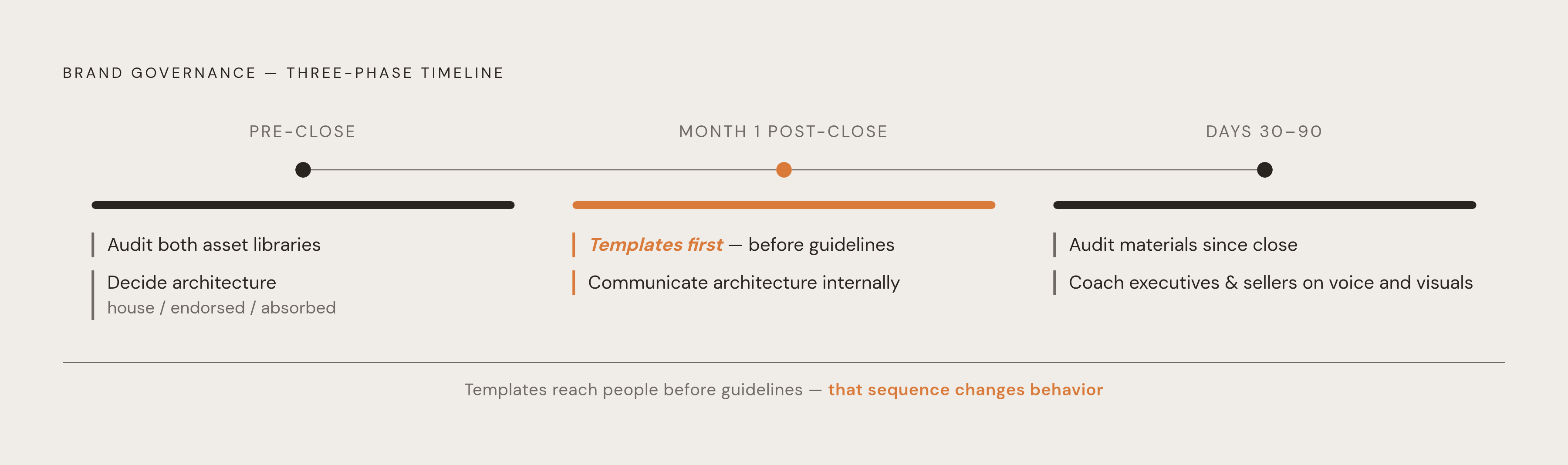
The 90 days right after close are the riskiest window for brand inconsistency, and the work to manage that risk has to start before the deal closes, not after, because employees start producing materials immediately whether or not the governance infrastructure is ready for them. DeSantis Breindel's nine-step guide is blunt about this: professional services clients should already be experiencing the new brand by the time the announcement goes out publicly, which puts the infrastructure work ahead of the press release, not behind it, and it requires the CMO involved from the earliest planning stages rather than brought in once the ink is dry.
Before close, the priority is an honest audit of both legacy asset libraries, figuring out what's actually in use and what carries real customer equity worth protecting. Alongside that audit, the architecture decision, house of brands, endorsed, or absorption, needs to get made and documented, because it determines how much governance scope is actually required.
Once the deal closes, the first month is about distribution and clarity more than refinement. Templates should reach people before the guidelines document does, since the template is what actually changes behavior and the guidelines just explain why. And the architecture decision needs to be communicated internally clearly enough that employees on both sides know which brand they're representing and how to represent it correctly.
By the time 30 to 90 days have passed, the work shifts toward auditing what's actually gone out the door since close, not to catch anyone doing something wrong, but to find where the governance system has gaps that need a new template or a clearer rule. And somewhere in this window, executives and sellers, the people producing the most externally visible materials and the least likely to read a brand guidelines PDF, need actual coaching on the new brand voice and visuals, not just a document dropped in their inbox.
How non-designer employees produce on-brand materials at scale
The defining shift in how post-merger teams operate is that design work used to belong to designers, and now it belongs to everyone. A seller, an SDR, a marketer, an operations lead on either legacy team is expected to make their own collateral, often right after close, often with zero design background and zero design support standing by.
A few hundred employees from two different companies multiply that effect, and the combined brand ends up looking incoherent even though nobody technically broke a rule they were ever told about.
The fix is a tool that only offers brand-compliant choices in the first place, the locked palette, the approved typefaces, layouts that were already vetted, so the easiest path for a non-designer is automatically the correct path. Nobody has to memorize the brand guide because the guide is baked into the interface itself. Moda takes this approach directly: every asset it produces is a fully editable design sitting on a real canvas, not a flattened image. A designer or brand owner sets the governance layer once, and the whole merged team inherits it without needing design training. A seller from the acquired company can build a compliant one-pager on their first day without learning new software and without filing a request to a design team that, realistically, may not exist for them yet in the new org chart.
Social posting makes the stakes obvious. When executives and sellers get coached to post on LinkedIn under the new brand, personal posts are the highest-reach content the company produces and the least controlled, by a wide margin. A governed social template gives that seller a starting point that's already on-brand, which cuts way down on the odds of a well-meaning post quietly broadcasting visual inconsistency to exactly the prospects and customers the merger is trying to reassure.
What visual brand governance produces beyond consistency
Get this right and the payoff isn't just a tidier-looking company. The payoff appears in how fast revenue recovers, how much friction the integration generates internally, and how quickly the combined brand becomes something customers actually trust rather than something they're still sizing up.
Start with revenue. A merged team that can turn out compliant, on-brand sales materials from day one, without waiting in a design queue or paying an agency retainer, closes deals earlier in the window when customer and prospect uncertainty about the merger is at its highest and the narrative is still up for grabs. Then there's the people side. DeSantis Breindel points to a united workforce as one of the clearest outcomes of a well-run post-merger brand effort, and that tracks: employees who actually understand the new brand and feel confident operating inside it carry less of the low-grade anxiety that spreads through a team producing materials with no clear direction.
Speed compounds both of those gains. And the brand equity built in those first 90 days doesn't evaporate once the integration settles. The deals making headlines this year, the ones in the eighty and forty billion dollar range, will be remembered for their price tags. Whether they're remembered as successful integrations comes down to something much smaller and much less glamorous: whether the sales deck someone sent out in week three looked like it belonged to one company or two.