Enforcing Brand Standards Across Remote and Distributed Teams
Distributed teams stay on-brand when the approved choice becomes the easy one, not the policed one.

A regional sales manager at a satellite office needs a one-pager in an hour for a call that got moved up. They just didn't have forty minutes to go hunting for the right file, so they used the one that was findable. That single decision, repeated across a hundred people in a dozen markets, is what brand inconsistency actually looks like on the ground. It isn't malice and it isn't carelessness, it's the predictable output of giving people a PDF and a deadline and hoping the two reconcile themselves.
Most companies already have brand guidelines. The guidelines didn't fail to exist. They failed to reach the moment where the decision actually got made.
Three structural reasons explain why distributed teams interpret the same document differently, and none of them have much to do with how thorough the document is. The first is distance. The third is the absence of any feedback loop. Off-brand work usually gets noticed by accident, weeks after it has already been in market, and by the time anyone flags it, the same person is a week away from making the identical call again on the next asset.
A static document, however well-written, was never built to govern a team moving at the speed distributed organizations move at. It can't tell a developer in Amsterdam which UI component is the approved one. It can't stop a contractor in Tokyo from grabbing a logo file off an old deck because it was the first search result. It can't update itself the week the brand refreshes. Somewhere, right now, someone is probably designing from a palette that's already obsolete.
This matters more than a design nitpick would suggest. Brand consistency in a distributed sales motion is a trust signal that appears in close rates, not a design department's pride project.
What tighter control produces
The instinctive response to brand drift is to tighten the leash, and that response reliably backfires. Add another approval layer, and teams route around it entirely under deadline pressure, because the client meeting is in two hours and the review queue has a four-day backlog. The off-brand content reaches the customer anyway, except now there's a broken process sitting on top of the original inconsistency.
The mechanics are almost comedic in their predictability. There's just more friction layered on top of the same drift, plus a queue of resentful marketers.
A fair objection surfaces here: surely some control has to exist, since fully open access to every brand asset would be worse than what's happening now. Control still matters, but it shouldn't be the primary lever, the thing an organization reaches for first and relies on most. The actual goal is making the on-brand choice the easy choice, and that requires infrastructure, not more gatekeepers standing between a marketer and a deadline.
Which leads to the real reframe: brand compliance can't be policed into existence across a distributed team, it has to be engineered into the tools people already use. That means moving brand standards out of documents people are supposed to remember to consult and into the templates and systems where the actual asset gets built. Once the constraint lives inside the system instead of inside someone's memory of a 40-page PDF, on-brand output happens by default.
What is locked and what is flexible
Before any tool gets selected or any template gets built, one decision has to get made first, and it's a strategic one rather than a design one: which brand elements are fixed everywhere, and which can flex by region or team or context.
The 80/20 rule of global branding gives this decision a usable shape. If changing the element would make a buyer in a different market wonder whether they're dealing with the same company, it belongs in the 80 percent, full stop.
Take a global cybersecurity firm as a concrete case. What flexes is the 20 percent: regional proof points tied to local compliance frameworks, imagery that reflects the actual team environments in that market, campaign angles that lean into regulatory pressures specific to EMEA or specific to APAC. They cannot swap out the type system because one office prefers a different sans-serif.
The failure runs in both directions, and one of them feels more tempting than the other. Too flexible, and the 20 percent expands by default, because without explicit limits there's no natural ceiling and version drift accelerates fast. Teams given real latitude inside genuinely clear limits tend to stay inside them. This boundary decision is the actual specification for every template and every access rule that follows. There's no building a locked-but-flexible template without first knowing, in writing, what's locked and what's flexible.
Locked-but-flexible templates and the path of least resistance
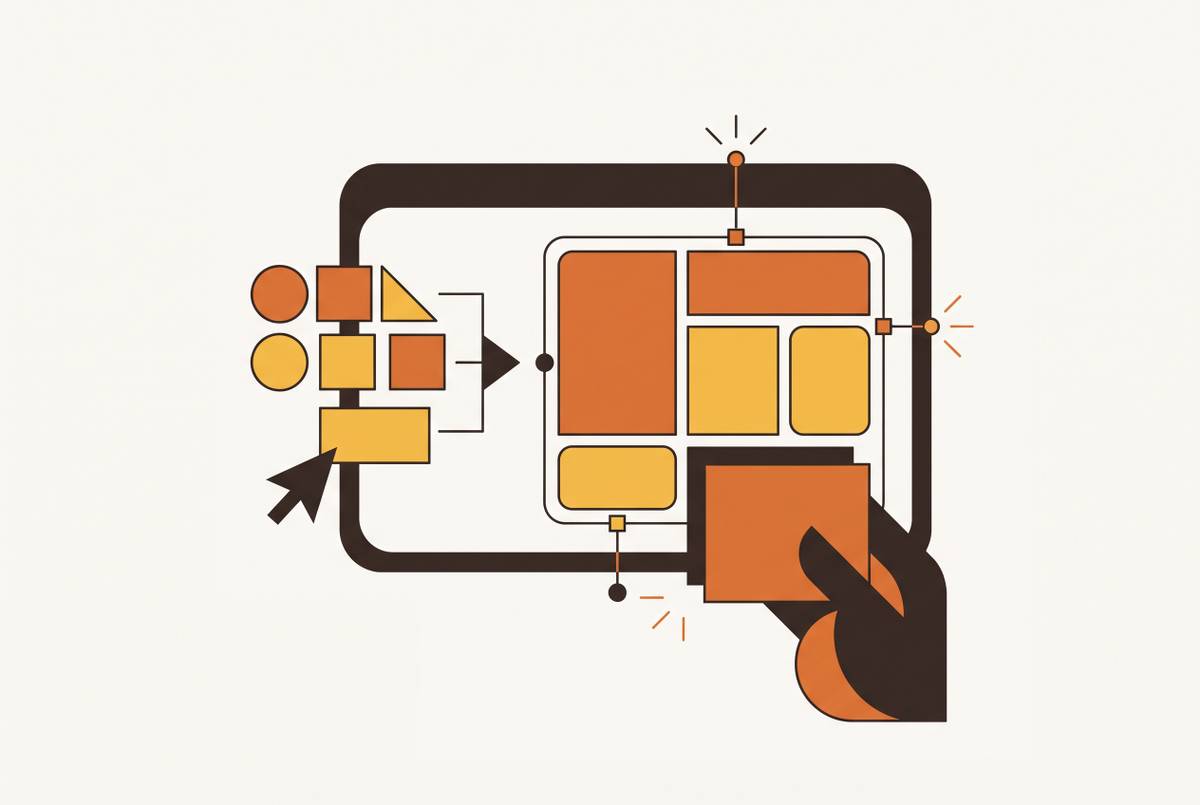
The real mechanism of brand enforcement at scale is a template architecture where the non-negotiable elements are structurally impossible to touch, and the flexible elements are genuinely easy to edit.
Locked-but-flexible has a specific, literal meaning. Governance happens by design, not because someone remembered to follow a rule.
Role-based permissions extend that same logic up through a whole organization's hierarchy. That's the exact environment this kind of architecture is built to handle.
The advantage over document-based governance is visible the moment the brand changes. Update the logo or the palette centrally, and every template reflects it immediately, instead of sitting in some regional folder waiting for someone to notice the old version is still circulating. For an organization managing assets across a dozen markets at once, that single property (instant propagation) does more for consistency than any policy memo could.
It also solves a problem that has nothing to do with goodwill. A locked template narrows the decision space down to exactly the choices that should vary by market, and removes the choices that shouldn't. The design decisions already got made upstream, freeing the person building the deck downstream to focus on getting the content right.
The infrastructure underneath the templates: brand hubs, asset management, and live guidelines
Templates govern the moment someone sits down to build something, but they're only as reliable as the place where approved assets actually live and the mechanism that keeps those assets current. Without that layer, even a well-built locked template starts to drift, because people will substitute whatever file is easiest to find the moment the right one isn't.
Most off-brand work isn't defiance. Fix that, and most of the problem solves itself: make the approved asset the one that's one search away, and bury the outdated one deep enough that finding it is more work than it's worth.
Three layers together do this job, replacing the static PDF with something that's actually alive. And a digital asset management system with scoped access means a team producing only internal memos doesn't get the keys to the full campaign photography library, because giving that kind of blanket access just raises the odds that the wrong image eventually turns up somewhere public.
Usage rules work best attached directly to the asset, right at the point someone downloads it, rather than tucked into a separate style guide nobody reopens. The same rule buried in page 34 of a guidelines document gets skipped, every time, because nobody thought to go check, not out of defiance.
Approval workflows need the same selectivity. Review processes that try to inspect everything that gets made collapse under their own weight, and the review queue itself becomes the bottleneck that drives people to bypass the system. When these three layers, hub, design system, scoped DAM, work together, the approved asset is not merely the correct choice but also the convenient one, which is the only version of "correct" that actually survives contact with a deadline.
AI-assisted governance: enforcing brand standards at the moment of creation, not after
Templates and asset infrastructure set the guardrails. A newer layer of tooling enforces those guardrails at the exact second a distributed team member is creating something, catching a problem before it reaches a customer.
Templating alone doesn't fully cover this. QA review catches issues at the tail end of a workflow, after the asset is basically finished; the mistake already got made somewhere upstream. And generative AI tools, left ungrounded in a specific brand's rules, will happily produce enormous volumes of content that sound plausible and look fine, without any actual tie to whether the output matches the brand.
Marq's Brand Guardian is a useful example of what catching things at the moment of creation actually looks like. Because the rules are built into the environment itself, AI can be used to generate content at real scale without that scale becoming a liability.
Whether the output is static or editable changes what governance even means in practice for teams using AI to generate visual assets. A static AI-generated image that comes out slightly off-palette, or with spacing that breaks a layout rule, or with copy that needs a compliance edit, can't be fixed. Governance and creative flexibility stop competing with each other at that point. That gap, between an image that has to be regenerated and a design that can simply be fixed, is what actually separates editable AI design tools from plain image generation for a distributed team trying to stay on-brand without slowing down.
The human layer: regional brand champions and the structural conditions that make the role work
Systems enforce what can be systematized. Cultural nuance, a judgment call about whether an image reads one way in one market and a completely different way in another, an edge case the template never anticipated: none of that gets caught by a permissions setting. It needs a person, embedded locally, with actual authority.
The Regional Brand Champion model puts one person in each major market in charge of the brand relationship on the ground. And they feed context back to the central brand team: local compliance quirks, cultural readings the headquarters team would have no way to anticipate, the edge cases no guideline ever covers because nobody thought of them in the room where the guideline got written.
Three conditions decide whether this role actually works or just becomes a title on an org chart. It needs an explicit mandate, spelled out, not a vague expectation that someone will "keep an eye on brand stuff" between other responsibilities. And the role needs real access to the infrastructure itself, the brand hub, the DAM, the template library, because a Brand Champion locked out of the systems everyone else is using can't actually do anything with the authority they've been handed.
Global consistency doesn't mean every market gets the identical execution. A B2B brand that takes its North American campaign messaging and drops it verbatim into APAC or EMEA isn't being consistent. The Brand Champion can tell transcreation, adapting the underlying idea to fit the local context, apart from plain translation, converting the words and calling it done, and knows when a call is above their pay grade and needs to go back to the center.
Putting it together: the sequence for moving from guidelines to a working brand system
None of these pieces work out of order. The systems and the human layer and the AI tooling all depend on a sequence, and the sequence starts with a decision, not a tool purchase.
Step one: write down the 80/20 boundary, explicitly, before anyone evaluates a single platform.
Step two: build or migrate to a live digital brand hub that actually replaces the PDF as the source of truth. Every team, wherever they're working from, needs to reach current guidelines and pull current assets from one URL, not a folder structure six people have slightly different versions of. Usage rules belong attached to each asset, not stranded in a separate document nobody opens twice.
Step three: build the locked-but-flexible template library, mapped directly onto the 80/20 boundary decided in step one. Connect every template back to the brand hub, so a centrally-updated logo or color pushes everywhere at once.
Step four: configure access and approval selectively. Scope asset access by role and region so each team's library only contains what's actually appropriate for their work.
Step five: appoint Regional Brand Champions in each major market, and give them what the role actually requires: dedicated time, a clear mandate, full access to the hub and the DAM and the template system. A real feedback loop between champions and the central brand team makes the edge cases they catch actually improve the system instead of evaporating into a message nobody follows up on.
The test for whether any of this is working is simple to state. Can someone on any team, in any market, find the right asset, build something on-brand, and publish it, without pinging central brand team for help? If the answer is yes, the system is doing its job. If the answer is no, the bottleneck is almost always one of three things. Findability is a hub or DAM problem. Template coverage means the library hasn't caught up to how the team actually works. Access scope means permissions are either too tight or too loose. Each of those has a specific, locatable fix. The goal was always a system where the on-brand version of anything is simply the easiest version to make, in every market, every time, without anyone having to think about it first.